
Thursday, May 29, 2014
The Media Lab Has Moved to Medium
The Media Lab has moved to a new blogging platform, Medium. You can still access our archive of Blogger posts here.

Tuesday, December 31, 2013
MIT Media Lab Year-End Round-Up
A sampling of the most amazing projects, the most exciting research, and the biggest news from the Lab in 2013.
Tod Machover, Peter Torpey, Akito Van Troyer, and Ben Bloomberg used Hyperscore and the Social Computing group’s DOG programming language to crowdsource and compose a symphony about Toronto.

The Director’s Fellows are a cohort of unique creators who bring inspiration and ideas to broaden the Lab community. They are an eclectic group, most coming from non-academic backgrounds, and are working with students and faculty on a number of exciting field projects.

The E14 Fund is an independent investment fund that gives recent Media Lab alumni a “six-month runway” to entrepreneurship, in the form of startup support that includes a stipend, legal advice, meetings with venture capitalists, and more. The program also incorporates a way to put a portion of the profits from successful spinoffs back into MIT.
Professor Ed Boyden, head of the Synthetic Neurobiology group, was one of six scientists awarded the Grete Lundbeck European Brain Research Prize. He was honored for his work in optogenetics, a technology that makes it possible to control brain activity using light.
A new technique that converts an ordinary camera into a light-field camera, from Kshitij Marwah, Gordon Wetzstein, Yosuke Bando, and Professsor Ramesh Raskar of the Camera Culture group. Focii is a light-field camera attachment and software tool that can produce a full, 20-megapixel multi-perspective 3D image from a single exposure of a 20-megapixel sensor.
A carving tool designed by postdoc Amit Zoran of the Responsive Environments group. FreeD allows the user to control the carving process while aided by a computer guidance system that is preprogrammed with the desired three-dimensional shape.

An email metadata visualization tool from Daniel Smilkov, Deepak Jagdish, and Professor César Hidalgo of the Macro Connections group. Immersion scans a user’s email account and creates a portrait of networked connections based on the From, To, Cc, and Timestamp fields.
An interactive dynamic display table from Sean Follmer, Daniel Leithinger, and Professor Hiroshi Ishii of the Tangible Media group. inFORM is a Dynamic Shape Display that can render 3D content physically, so users can interact with digital information in a tangible way. inFORM can also interact with the physical world around it, for example moving objects on the table’s surface.
An automated conversation coach that helps with interview skills, social interactions, and conversational skills from Ehsan Hoque of the Affective Computing group. MACH, or My Automated Conversation CoacH, is a software program that simulates face-to-face interactions in different social and professional contexts, and offers feedback to improve performance.

Two new faculty members joined the Lab in 2013: Kevin Slavin, head of the new Playful Systems group, which explores how the systems that increasingly run our lives can be brought to the foreground through games, narratives, and visualizations; and Hiromi Ozaki, also known as Sputniko!, whose new group Design Fictions will explore the social, cultural, and ethical implications of new technologies.

A new version of the programming language for kids from the Scratch Team in the Lifelong Kindergarten group. Scratch 2.0 provides updates to the Scratch programming language and online community that enables kids (ages eight and up) to create their own interactive stories, games, music, and animations for the Web. A new, cloud-based version includes ways for youths to create new types of projects and work together in new ways. In November, the Nominet Trust in England included Scratch on its list of "The World’s Most Inspiring Social Innovations Using Digital Technology."

A solar-powered park bench that charges your phone from Nan Zhao of the Responsive Environments group, visiting scientist Sandra Richter of the Changing Places group, and MIT alum Ines Gaisset. The two seat-e benches installed on the Rose Fitzgerald Kennedy Greenway provide power to recharge mobile phones, a wi-fi Internet connection, and light at night.
An exploration of the relationship between digital and biological fabrication from Professor Neri Oxman, Jorge Duro-Royo, Carlos Gonzalez, Markus Kayser, and Jared Laucks of the Mediated Matter group. The Silk Pavilion comprises a dome of CNC-deposited silk threads, onto which the researchers placed 6,500 silkworms at the bottom rim of the primary structure, spinning flat non-woven silk patches across the gaps in the dome. The silkworms were affected by spatial and environmental conditions such as the density of the existing silk threads and variation in temperature and sunlight; they migrated to darker and denser areas, creating a unique pattern of spun silk across the dome.
A project that uses augmented reality technology to program physical objects and their interactions, led by Valentin Heun of the Fluid Interfaces group. Smarter Objects allow users to imbue tangible objects with virtual interfaces, giving the virtual and physical worlds new ways to interact.

A tool to examine who's watching what, when, and where, all over the world, created by Ed Platt, Rahul Bhargava, and Ethan Zuckerman of the Center for Civic Media. What We Watch collects data from Youtube’s Trends Dashboard to determine what videos are popular in any of 61 countries at any given time; it then compares the video trends in one country to those in other countries.
Anthozoa
 |
| Photo credit: Yoram Reshef for Stratasys |
A 3D-printed ensemble created by Professor Neri Oxman, head of the Mediated Matter group, for Dutch designer Iris van Herpen’s collection, “Voltage,” at Paris Fashion Week. The 3D-printed skirt and cape, called Anthozoa, were produced using Stratasys’ Objet Connex multi-material 3D printing technology.
CityScope
 |
| Photo credit: Jonathan Williams |
An urban design system that combines high-definition video projectors, advanced modeling and simulation technology, 3D projection mapping, and physical models, created by Kent Larson and a team from the Changing Places group. CityScope provides a real-time, interactive data environment for understanding and designing relationships between people and places in cities.
Collaborative, Crowd-Sourced Symphonies
Led by Professor Tod Machover, the Opera of the Future group created new software tools to crowdsource music for collaborative music compositions in Toronto and Edinburgh.Toronto Symphony: Concerto for Composer and City
Tod Machover, Peter Torpey, Akito Van Troyer, and Ben Bloomberg used Hyperscore and the Social Computing group’s DOG programming language to crowdsource and compose a symphony about Toronto.
“Festival City” at the Edinburgh International Festival
 |
| Photo source: http://www.eif.co.uk/blog/festival-city-project |
Akito von Troyer and Tod Machover created Constellation and Cauldron to gather and remix music
samples contributed by citizens and lovers of Edinburgh.
Director’s Fellows Program

E14 Fund

The E14 Fund is an independent investment fund that gives recent Media Lab alumni a “six-month runway” to entrepreneurship, in the form of startup support that includes a stipend, legal advice, meetings with venture capitalists, and more. The program also incorporates a way to put a portion of the profits from successful spinoffs back into MIT.
Ed Boyden Awarded the Brain Prize
 |
| Photo credit: Dominick Reuter |
Focii
A new technique that converts an ordinary camera into a light-field camera, from Kshitij Marwah, Gordon Wetzstein, Yosuke Bando, and Professsor Ramesh Raskar of the Camera Culture group. Focii is a light-field camera attachment and software tool that can produce a full, 20-megapixel multi-perspective 3D image from a single exposure of a 20-megapixel sensor.
FreeD
A carving tool designed by postdoc Amit Zoran of the Responsive Environments group. FreeD allows the user to control the carving process while aided by a computer guidance system that is preprogrammed with the desired three-dimensional shape.
Immersion

inFORM
An interactive dynamic display table from Sean Follmer, Daniel Leithinger, and Professor Hiroshi Ishii of the Tangible Media group. inFORM is a Dynamic Shape Display that can render 3D content physically, so users can interact with digital information in a tangible way. inFORM can also interact with the physical world around it, for example moving objects on the table’s surface.
Joe Jacobson Wins the Exner Medal
 |
| Photo credit: Shuguang Zhang |
Professor Joe Jacobson, head of the Molecular Machines group, was honored with a Wilhelm Exner Medal for his contributions to microelectronics. The Exner Medal is awarded to scientists and researchers whose work has directly impacted business and industry.
MACH
An automated conversation coach that helps with interview skills, social interactions, and conversational skills from Ehsan Hoque of the Affective Computing group. MACH, or My Automated Conversation CoacH, is a software program that simulates face-to-face interactions in different social and professional contexts, and offers feedback to improve performance.
New Faculty: Kevin Slavin and Sputniko!

The Privacy Bounds of Human Mobility

Yves-Alexandre de Montjoye of the Human Dynamics group and Professor César Hidalgo of the Macro Connections Group used 15 months of data from 1.5 million people to show that 4 points—approximate places and times—are enough to identify 95 percent of individuals in a mobility database. These findings have been recently used to understand the use of metadata by the NSA and have been cited in numerous media reports and editorials. Their paper, “Unique in the Crowd: The Privacy Bounds of Human Mobility,” was published in Nature.
Science Fiction to Science Fabrication
 |
| Photo credit: Guillermo Bernal |
A class instructed by Dan Novy of the Object-Based Media group and Sophia Brueckner of the Fluid Interfaces group, exploring the relationship between science fiction and speculative/critical design as a means of encouraging the ethical and thoughtful design of new technologies. Students built projects based on concepts from sci fi and blogged about their work. The class was featured in an interview with the instructors in The Atlantic.
Scratch 2.0
Seat-e

The Silk Pavilion
An exploration of the relationship between digital and biological fabrication from Professor Neri Oxman, Jorge Duro-Royo, Carlos Gonzalez, Markus Kayser, and Jared Laucks of the Mediated Matter group. The Silk Pavilion comprises a dome of CNC-deposited silk threads, onto which the researchers placed 6,500 silkworms at the bottom rim of the primary structure, spinning flat non-woven silk patches across the gaps in the dome. The silkworms were affected by spatial and environmental conditions such as the density of the existing silk threads and variation in temperature and sunlight; they migrated to darker and denser areas, creating a unique pattern of spun silk across the dome.
Smart Prosthetics
 |
| Photo credit: Simon Bruty |
After the April 2013 Boston Marathon bombings, Professor Hugh Herr and the Biomechatronics group informed the public on advances in smart prosthetics research and began working directly with some of those injured in the attack. Professor Herr wrote an op-ed for The Wall Street Journal about this work.
Smarter Objects
What We Watch

A tool to examine who's watching what, when, and where, all over the world, created by Ed Platt, Rahul Bhargava, and Ethan Zuckerman of the Center for Civic Media. What We Watch collects data from Youtube’s Trends Dashboard to determine what videos are popular in any of 61 countries at any given time; it then compares the video trends in one country to those in other countries.
Tuesday, November 12, 2013
Heads Up on Fellowships for Solid
This coming May 22-21, I'll be in San Francisco to co-chair Solid: Software / Hardware / Everywhere, a conference exploring what's next at the intersection of software and the physical world.
This is an inaugural conference sponsored by O'Reilly Media, and we're encouraging everyone from grad students, to artists, to managers, to top-level execs to come and engage in a multidisciplinary conversation about what's coming next.
To make sure that some of the best and the brightest (regardless of financial circumstances) are able to attend, we're offering ten Solid fellowships to any full-time student or independent innovator who is working on a project within the scope of Solid.
Each fellow will receive:
- $1,000 stipend
- A free pass to attend Solid
- Assistance with travel expenses to the conference
You can get more info and apply here; the deadline is January 15 (11:59 PST).
If you're interested in being a presenter, there's a December 9 deadline for sending in a proposal, which will be reviewed by a diverse programming committee. The process is open to anyone. And if your proposal is accepted, you will get a free pass to the entire event.
More to come as we get closer to the event.
Joi Ito is Director of the MIT Media Lab.
Thursday, October 3, 2013
Welcome New Students!
Perhaps the most important annual event at the Media Lab is the infusion of new talent each September. As a new semester gets underway, new students bring to this Lab a rich and vibrant set of experiences and ideas that renews our spirit of possibility. This year, we welcome one of the largest contingent of masters' students in the history of the Lab—47 bright individuals who will be embarking on a journey of unleashing their creativity and smarts during the next two years. We couldn't be more thrilled for them.
If you're a new student settling down at the Lab, initially you can feel a lot like a child in a candy shop at one end and also feel a teensy bit overwhelming at the other. A dazzling array of courses, spellbinding research across MIT, and an enthusiastic community on campus can be both endlessly interesting and daunting at the same time. But we have not a shred of doubt that you are going to do great things while you're here. It's sort of like a convex optimization formulation in machine learning—you are positioned to succeed by converging on your objectives. So, as you begin your journey here at MIT, we thought we'd share a few snippets with you.
- Reject the impostor syndrome | Your admission to the Media Lab was not by accident. You were selected from hundreds of competent and competitive folks. Please do not doubt your abilities. It can feel intimidating to be surrounded by extraordinary people, but never second guess your own abilities and talents.
- Focus on super health | Being a graduate student at MIT is a bit like being an athlete, where health and fitness are of paramount importance. Please triple down on positive habits that elevate your well-being. We want you to conquer the diathesis-stress model by optimizing healthy diet, exercise, and sleep. You'll find it only amplifies your creativity and the effectiveness of your research trajectory.
- Talk to the polymaths | The Media Lab is filled with faculty members who are not only pioneers in their own fields, but also have deep expertise in other fields. It is a function of our antidisciplinary approach to things. Some of our best experiences have been deep and astute discussions with our brilliant faculty.
- Spread your wings further | One of the most powerful aspects of being a Media Lab student is that there are very few required classes. You are free to take any class at MIT and can cross-register at Harvard as well. It's resulted in some long-lasting collaborations for many former and current students. If you are on the cusp of a spin-off, the world is at your command in terms of mobilizing resources here at MIT.
There are few places on this planet like MIT—from the invention of single-electron transistors to formulating information theory, the scientific acumen, gravitas, and impact that has emanated from this great campus still gives us goosebumps. We're all so lucky to be here. MIT's capacity to inspire and lead is perennial. Now you are a part of this family and every magical attribute of it, and we couldn't be more excited about you and the work that you will be crafting during your stay here.
Karthik Dinakar is a PhD student in the Media Lab's Software Agents and Affective Computing groups.
Birago Jones is the president of the MIT Media Lab Alumni Association
Joost Bonsen is a lecturer in the Media Lab's Human Dynamics group
Friday, August 16, 2013
Repertoire Remix: The Sounds of Edinburgh
Composer Tod Machover is creating a "collaborative symphony" called Festival City, to premiere on August 27 at the Edinburgh International Festival (EIF). The work is a sonic portrait of Edinburgh—city and festival—created with input from those who love the city. Machover has been soliciting audio samples of, and stories about, the city, as well as providing tools created by members of the Opera of the Future research group at the MIT Media Lab that will allow everyone to help shape the composition.
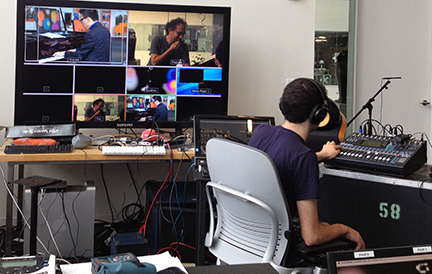
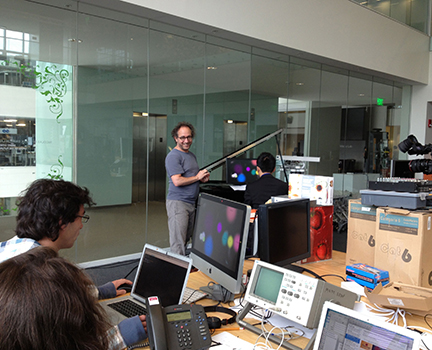
On Tuesday, July 9, 2013, Tod Machover and his team presented a one-time-only event to further shape Festival City. Participants in the live-stream event helped to select musical elements from the repertoire of pieces performed at the EIF since its inception in 1947, and pianist Tae Kim combined these repertoire fragments together in real time in constantly evolving ways, following input from online participants.
The simple web interface, Cauldron, showed a colored bubble for each composer selected; participants could "stir" with their mouse on the screen, and the closest "composer bubble" grew in size. At the same time, Machover was controlling a second interface to determine how the composer-fragments related to one another. Input from online participants and Machover immediately changed the size, appearance, and behavior of the bubbles, thus creating Kim's "score" for the improv session, which he followed and performed in real time.
Over 1,000 people participated in the hour-long Repertoire Remix project on The Guardian website. Aside from participants from Edinburgh and Cambridge/Boston, we were pleased to see participants from all over the UK: Aberdeen, Basingstoke, Bristol, Canterbury, Chester, Cornwall, Coventry, Inverness, Leeds, London, Macclesfield, Manchester, Newcastle, Norfolk, Norwich, Nottingham, Shropshire, Sussex, and Sheffield. People also joined from all over the world: Brazil; Toronto, Canada; Beijing, China; Paris, France; Stuttgart, Germany; Kinsale, Ireland; Amsterdam, The Netherlands; California, Indiana, and New York, USA; Thailand; and Turkey.
Monday, July 22, 2013
Google Glass and the Eyewitness/Journalist Gap
Before Edward Snowden leaked documents that revealed widespread NSA monitoring of digital communications, the introduction of Google Glass encouraged people to talk about surveillance. In the wake of revelations of massive data collection by an opaque government agency, concerns about Google Glass-wearing patrons recording private conversations in bars seem minor in comparison. But a recent video has reopened conversation about Google Glass, surveillance, and privacy at a moment where cameras are pervasive.
Chris Barrett, a PR professional who is one of the few thousands beta testers of Google Glass, posted a video on YouTube on July 4, announcing, "This video is proof that Google Glass will change citizen journalism forever." The video, which Barrett shot on the boardwalk in Wildwood, New Jersey, features the tail end of a fist fight and the arrest of two participants by local police. Discussing the video with Venture Beat, Barrett explained the benefit of Google Glass in filming these events: "I think if I had a bigger camera there, the kid would probably have punched me. But I was able to capture the action with Glass and I didn't have to hold up a cell phone and press record."
Despite Barrett's fear of being assaulted, I noticed that many of the other witnesses of the fight also decided to film events with their phones, and none were menaced by the police or the brawlers. Google Glass, capable of surreptitiously recording video, is less a revolution than an extension of an existing trend: we all carry cameras and, when something out of the ordinary happens, we record it.
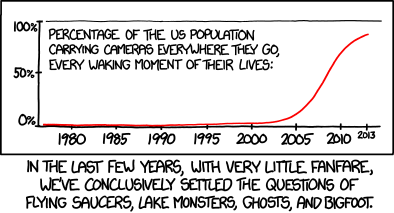
Randall Munroe, one of the Internet's most astute social commentators, has already thought through one of the key implications of pervasive cameras: if 10 million tourists with camera phones haven't photographed the Loch Ness Monster, we can probably finally declare it a myth. But the most thoughtful commentator on the implications of pervasive cameras is a man who's been wearing a camera for years: Steve Mann.
Dr. Steve Mann is a professor at the University of Toronto, an alum of the Media Lab, and a pioneer in the design of wearable computer systems. Since 1981, he has been building and wearing computer systems that can record what he sees, as well as superimpose computer-generated imagery on his field of vision. Mann has logged tens of thousands of hours wearing different generations of his EyeTap system, and has written eloquently about both how he uses the tool and how others react to him when he's wearing a camera.
Mann coined the term "sousveillance," watching from below, as an alternative to "surveillance," watching from above. When the UK government deploys 1.85 million cameras to monitor city streets, or the US government intercepts billions of communications, these powerful institutions send a message: consider yourself watched at all times and behave accordingly. Mann suggests that we might invert the paradigm by pointing the camera at institutions and authorities, reminding them that citizens are watching as well.
Compared to the power of monitoring all digital communications in a nation, the ability to film police making an arrest initially seems like weak tea. (Even asserting rights to this form of sousveillance has required protracted legal battles, and commentator Steve Silverman strongly discourages people from recording police surreptitiously, as Barrett did.) But protesters in the Occupy movement took to live-streaming video from their encampments, both to share proceedings with people who couldn't be physically present, and to ensure that any police violence would be documented and broadcast. (Charlie DeTar, a doctoral student at the Media Lab, produced a map visualizing these streams.) The firing of Lt. John Pike, the infamous "pepper-spray cop" who assaulted students at UC Davis, suggests that this documentation of abuse was effective.
Sousveillance has also become a routine part of election monitoring in much of the world. Enabled by technologies like Ushahidi, which allows thousands of people to report on an event and place their reports on an interactive map, citizen monitoring of elections by photographing long lines at polling places or voting irregularities has become common practice in much of the world.
When Barrett declares a revolution in citizen journalism due to Google Glass, he's thinking of this sense of sousveillance. With widespread use of Google Glass, it's more likely that abuses of power will be documented, as well as natural disasters and breaking news. But Barrett's video shows that there's a giant gap between an eyewitness account and a journalistic story. Yes, Barrett's video shows an arrest, but it doesn't help us figure out who was fighting and why, or what happened to the men after they were arrested. Pervasive cameras create more inputs for journalism, but they don't automatically answer the questions of who, what, where, and why that we expect of good journalism.
When Mann discusses sousveillance, he often talks about another facet of the idea: by wearing a camera and pointing it at people, he forces people to think about the implications of being watched. People often react badly to Mann's sousveillance, complaining that his camera is an invasion of their privacy. Mann hopes that this discomfort at being watched will inspire deeper consideration of the ways people are watched by corporations and governments.
Watching Barrett's video, it's easy to feel uncomfortable: for the people watching in the crowd who now feature in his film, and for the participants in the fight who've now been viewed by almost a million people online. Perhaps that discomfort will translate into a discussion of societal norms around cameras and lead to a legal or societal agreement that we don't record people without their permission—except in extraordinary circumstances.
There's another possibility. If Google Glass and other wearable cameras become pervasive, the uncomfortable and provocative experience of being watched eventually disappears and we simply get used to the idea that public spaces are spaces in which we expect to be filmed. Before we accede to that possibility, it's worth having an extended conversation about the balance between the power we gain from sousveillance and the constraints that surveillance puts on our behavior.
Ethan Zuckerman is director of the MIT Center for Civic Media.
Chris Barrett, a PR professional who is one of the few thousands beta testers of Google Glass, posted a video on YouTube on July 4, announcing, "This video is proof that Google Glass will change citizen journalism forever." The video, which Barrett shot on the boardwalk in Wildwood, New Jersey, features the tail end of a fist fight and the arrest of two participants by local police. Discussing the video with Venture Beat, Barrett explained the benefit of Google Glass in filming these events: "I think if I had a bigger camera there, the kid would probably have punched me. But I was able to capture the action with Glass and I didn't have to hold up a cell phone and press record."
Despite Barrett's fear of being assaulted, I noticed that many of the other witnesses of the fight also decided to film events with their phones, and none were menaced by the police or the brawlers. Google Glass, capable of surreptitiously recording video, is less a revolution than an extension of an existing trend: we all carry cameras and, when something out of the ordinary happens, we record it.
Randall Munroe, one of the Internet's most astute social commentators, has already thought through one of the key implications of pervasive cameras: if 10 million tourists with camera phones haven't photographed the Loch Ness Monster, we can probably finally declare it a myth. But the most thoughtful commentator on the implications of pervasive cameras is a man who's been wearing a camera for years: Steve Mann.
Dr. Steve Mann is a professor at the University of Toronto, an alum of the Media Lab, and a pioneer in the design of wearable computer systems. Since 1981, he has been building and wearing computer systems that can record what he sees, as well as superimpose computer-generated imagery on his field of vision. Mann has logged tens of thousands of hours wearing different generations of his EyeTap system, and has written eloquently about both how he uses the tool and how others react to him when he's wearing a camera.
Mann coined the term "sousveillance," watching from below, as an alternative to "surveillance," watching from above. When the UK government deploys 1.85 million cameras to monitor city streets, or the US government intercepts billions of communications, these powerful institutions send a message: consider yourself watched at all times and behave accordingly. Mann suggests that we might invert the paradigm by pointing the camera at institutions and authorities, reminding them that citizens are watching as well.
Compared to the power of monitoring all digital communications in a nation, the ability to film police making an arrest initially seems like weak tea. (Even asserting rights to this form of sousveillance has required protracted legal battles, and commentator Steve Silverman strongly discourages people from recording police surreptitiously, as Barrett did.) But protesters in the Occupy movement took to live-streaming video from their encampments, both to share proceedings with people who couldn't be physically present, and to ensure that any police violence would be documented and broadcast. (Charlie DeTar, a doctoral student at the Media Lab, produced a map visualizing these streams.) The firing of Lt. John Pike, the infamous "pepper-spray cop" who assaulted students at UC Davis, suggests that this documentation of abuse was effective.
Sousveillance has also become a routine part of election monitoring in much of the world. Enabled by technologies like Ushahidi, which allows thousands of people to report on an event and place their reports on an interactive map, citizen monitoring of elections by photographing long lines at polling places or voting irregularities has become common practice in much of the world.
When Barrett declares a revolution in citizen journalism due to Google Glass, he's thinking of this sense of sousveillance. With widespread use of Google Glass, it's more likely that abuses of power will be documented, as well as natural disasters and breaking news. But Barrett's video shows that there's a giant gap between an eyewitness account and a journalistic story. Yes, Barrett's video shows an arrest, but it doesn't help us figure out who was fighting and why, or what happened to the men after they were arrested. Pervasive cameras create more inputs for journalism, but they don't automatically answer the questions of who, what, where, and why that we expect of good journalism.
When Mann discusses sousveillance, he often talks about another facet of the idea: by wearing a camera and pointing it at people, he forces people to think about the implications of being watched. People often react badly to Mann's sousveillance, complaining that his camera is an invasion of their privacy. Mann hopes that this discomfort at being watched will inspire deeper consideration of the ways people are watched by corporations and governments.
Watching Barrett's video, it's easy to feel uncomfortable: for the people watching in the crowd who now feature in his film, and for the participants in the fight who've now been viewed by almost a million people online. Perhaps that discomfort will translate into a discussion of societal norms around cameras and lead to a legal or societal agreement that we don't record people without their permission—except in extraordinary circumstances.
There's another possibility. If Google Glass and other wearable cameras become pervasive, the uncomfortable and provocative experience of being watched eventually disappears and we simply get used to the idea that public spaces are spaces in which we expect to be filmed. Before we accede to that possibility, it's worth having an extended conversation about the balance between the power we gain from sousveillance and the constraints that surveillance puts on our behavior.
Ethan Zuckerman is director of the MIT Center for Civic Media.
Tuesday, June 18, 2013
Welcome to New Faculty Member Hiromi Ozaki!

Hiromi Ozaki, also known as Sputniko!, has joined the Media Lab as an assistant professor. An artist who uses design to explore technology's impact on everyday life–and to imagine the future–Ozaki’s art practice includes creating songs and music videos about products she has designed, which she posts on social networks and online video platforms to encourage discussion outside traditional academic spheres.
"Hiromi Ozaki's art provokes people to think about the social, cultural, and ethical implications of new technologies. We're looking forward to seeing what happens when she brings her great energy, imagination, and creativity to the Media Lab," says Professor Mitchel Resnick, head of the Media Lab's academic Program in Media Arts and Sciences.
Ozaki's cross-boundary work is emblematic of the Media Lab's antidisciplinary, collaborative environment, and her research at the Lab will explore storytelling and embrace the social, cultural, and ethical implications of technology created at the Lab. She envisions her research at the Media Lab as deeply symbiotic and collaborative with other Lab research groups, with the aim of stimulating and developing new technologies that will, in turn, encourage discussions both within and outside the MIT Media Lab, as well as to inspire and shape future Lab innovations.
"The key thing that excites me about Hiromi's work is that she elegantly synthesizes science, computation, networking, art, and design into beautiful "hacks" very appropriate to the contemporary medium of the Internet–social media, video, music and social commentary," says Media Lab director Joi Ito. "She's a true artist and producer that will connect to the Media Lab at many of its levels."
Hiromi Ozaki has presented her film and installation works at exhibitions such as Talk to Me (MoMA, New York, 2011), Transformation (Museum of Contemporary Art Tokyo, 2010), Light of Silence (Aomori Museum of Art, 2012), and the Third Art & Science International Exhibition in Beijing (2012). She has received the “Passion without Borders” Award from the Japan National Policy Unit's Cabinet Secretariat (2012), an honorary mention in both Ars Electronica's Hybrid Art Category (2013) and Interactive Art Category (2012), and Jury Recommended Works at the 14th Japan Media Arts Festival (2011). Recognized as an active social media influencer in Japan, the Japanese Ministry of Economy, Trade and Industry (METI) selected Ozaki as the youngest member of the Cool Japan Advisory Council (2012-2013). She received her MA in design interactions at the Royal College of Art, London. Prior to studying at the RCA, she received her BSc in mathematics and computer science at Imperial College, University of London.
Friday, May 24, 2013
People Analytics: Using Social Sensing Technology to Transform Organizations
People analytics is simultaneously an extremely old and new phenomenon. When we use data to uncover the workplace behaviors that make people effective, happy, creative, experts, leaders, followers, connectors, early adopters, and so on, we are using people analytics. Thousands of years ago, this data came from everyday observations of the world. By watching their peers interact with other people and react to changing conditions, people were able to make educated guesses about what made them effective and happy. Later, we augmented our senses using surveys and interviews. These methods allowed us to gather responses from thousands of people, establishing new metrics that were a bit more quantitative, but this did not herald any radical change in the way people run companies.
 Today, people analytics is poised for a revolution, and the catalyst is the explosion of hard data about our behavior at work, drawn from a wide variety of sources. Digital traces of activity from email records, web browsing behavior, instant messaging, and all the other IT systems we use give us incredibly detailed data on how people work. Who communicates with whom? How is IT tool usage related to productivity? Are there work styles that aren’t well-supported by current technology? Although this data can provide amazing insights, it’s only the digital part of the story.
Data on the physical world is also expanding at a breakneck pace thanks to the rapid development of wearable sensing technology. These sensors, from company ID badges to cell phones to environmental sensors, provide reams of fine-grained data on interaction patterns, speaking patterns, motion, and location, among other things. Because most communication and collaboration happens face to face, this data is critical for people analytics to take that next leap forward and become a transformative organizational tool. By combining precise data from both real and virtual worlds, we can now understand behavior at a previously unimaginable scale.
Through my work with colleagues in the Media Lab’s Human Dynamics group, we’ve developed a compelling set of case studies illuminating a new kind of people analytics. In particular, we’ve seen how slight changes in behavior–from changing when you take breaks to what lunch tables you sit at–can make you happier, healthier, and more productive. Our work shows how people analytics transforms our understanding of socialization in the workplace, the impact of office layout, and even concepts as “soft” as creativity.

Looking to the future, we can use this knowledge to create fundamentally new ways of organizing people that will radically improve the way we work. Office layouts that respond to social context and real-time feedback on communication patterns and interaction styles are new levers enabled by people analytics that no one could have imagined. The years ahead will offer many new opportunities for people analytics that cannot possibly be anticipated. My new book, not coincidentally titled People Analytics, explores some of those limitless possibilities, their foundations in history, and some paths to the future.
Ben Waber is a visiting scientist at the MIT Media Lab, where he received his PhD. He is president and CEO of Sociometric Solutions, a management services firm that uses social sensing technology. His work centers around using real-time data flows to rethink management of people, physical architecture, corporate planning, and training, among other things. He is the author of People Analytics: How Social Sensing Technology Will Transform Business and What It Tells Us about the Future of Work.
Friday, May 10, 2013
May at the Media Lab: Upcoming Conversations
The academic year is reaching its end, but the Media Lab Conversations series is still full-speed ahead. Our two upcoming events are open to the public; please join us here at the Lab for what promise to be serious and thoughtful discussions. If you can't attend in person, you can participate via webcast and on Twitter with hashtag #MLTalks.
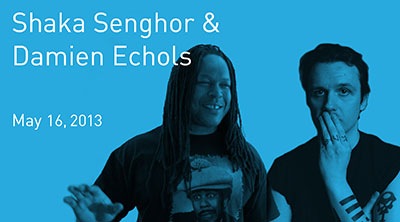
On May 16, in collaboration with the Boston Book Festival, we welcome Media Lab Director’s Fellow Shaka Senghor, who will be in conversation with Damien Echols. Their conversation will be moderated by Bob Oakes, host of 90.9 WBUR's Morning Edition. A compelling writer and speaker, Shaka Senghor’s story—which includes 19 years in prison—has become a tale of redemption and atonement. Damien Echols spent 19 years on death row after his murder conviction as one of the West Memphis Three. After his release in 2012, Echols wrote his memoir, Life After Death. This event is ticketed, with a portion of the proceeds going to support the Prison Book Program. More information about tickets is available.
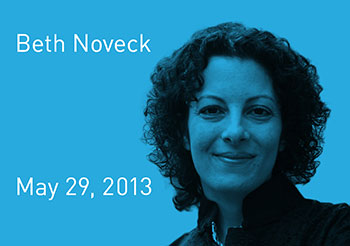
On May 29, we welcome Beth Noveck. Professor Noveck’s work focuses on scholarship, activism, and teaching on the future of democracy in the 21st century. Specifically, her work addresses how we can use technology to create more open and collaborative government. With a grant awarded to New York Law School from the John D. and Catherine T. MacArthur Foundation, she is collaborating with colleagues to create a research network on the impact of technology on democratic institutions. She’ll discuss these and other topics with Media Lab Director Joi Ito.
Thursday, April 11, 2013
Why the Media Lab is Important for Science: A Neurotechnology Story
Last week at a White House event, President Obama announced his Brain Research through Advancing Innovative Neurotechnologies (BRAIN) Initiative. Calling it "the next great American project," Obama allocated $100 million per year, starting in fiscal year 2014, for developing new tools to map the activity of the networks of the brain. In December of 2012 I contributed to a technology roadmap workshop for the initiative, and last week I was invited to participate in the official White House launch, along with other neuroscientists, engineers, and government officials.
The potential impact is huge. Understanding how sensations, decisions, emotions, and actions are generated by brain circuits has tremendous implications for understanding the human condition. Revealing the activity patterns associated with brain disorders, and their treatment, could help the one billion people worldwide who are afflicted with poorly treatable conditions ranging from epilepsy to Alzheimer’s. The technologies we develop in the Synthetic Neurobiology group at MIT, often in interdisciplinary collaborations, will provide key technology building blocks for this effort. These tools include optogenetic tools for controlling brain circuits with light, microfabricated 3D brain-spanning neural interfaces, and robots that automatically analyze single cells in the living brain.
Our group is a joint enterprise across multiple MIT institutes, such as the Media Lab and the McGovern Institute, and many departments such as Biological Engineering and Brain and Cognitive Sciences. We also work closely with other institutes like the Allen Institute for Brain Science. It’s instructive to take a look at one of these environments, the MIT Media Lab, and how it has helped the relatively new field of neurotechnology thrive, perhaps in unexpected ways. The Media Lab provides an antidisciplinary environment where fields that don’t fit within existing disciplines can be incubated and nurtured by people who believe in them. Giving a field some protected time to develop and ultimately prove itself, and to derive its methodologies of thinking, doing, and evaluating, is important for enabling it to mature to the point of having impact on the world.
One important methodology in neurotechnology is to engage in co-equal collaborations. For example, the brain-spanning interfaces were developed in collaboration with the Fonstad lab at MIT, and the single-neuron analysis robot was developed in collaboration with the Forest lab at Georgia Tech. To help people create impactful neurotechnology inventions, we have developed courses ranging from those that teach basic principles, to those that mentor people in the process of launching neurotechnology startup companies. It wasn’t all fun and games—for example, we had to renovate old film studios and holography rooms into functioning bioengineering labs, which took years. But it has been said that entrepreneurship is the pursuit of opportunity independent of the resources that you currently control. What you need is the right environment, and the potential to access resources and grow. The Media Lab lets us practice intellectual entrepreneurship, and over the last seven years, we have been able to accomplish this kind of growth, both within our group and in the field globally.
No field stays antidisciplinary forever. Technologies developed by our group are used all over the world. Our alumni and collaborators have been building new research groups, and startup companies, that are pushing the field of neurotechnology forward, both academically and from an industry-building standpoint. Certainly the White House announcement means that neurotechnology is in some ways going mainstream. The field is poised to grow and accelerate in ways not imaginable seven years ago. We are looking forward to helping build new technologies and new collaborative networks to make new technologies. And, always in the background is the question—prompted each time I walk down the hallways of the Media Lab complex—is it time to start incubating something new?
Ed Boyden is Benesse Career Development Professor and Associate Professor of Media Arts and Sciences at the MIT Media Lab. He is the head of the Synthetic Neurobiology group, and has joint appointments with MIT's Departments of Biological Engineering and Brain and Cognitive Sciences. He is an investigator at the MIT McGovern Institute.
Thursday, April 4, 2013
Of High-Speed Internet, Entrepreneurship, and Surprising Facts: the ML Conversations Series
The Media Lab’s 2013 Conversations Series is off and running, with two fantastic talks in the last two weeks.


On March 28, author Susan Crawford spoke with Ethan Zuckerman and Andy Lippman about her new book, Captive Audience, and the disparities in Internet speeds in the US caused by telecom companies’ monopoly. In Crawford’s view, "We should be able to take connectivity for granted - it should be ubiquitous, like the air we breathe." Instead, however, we’re faced with high costs and limited options, and yet none of the fastest cities in the world for Internet connectivity are in the US. You can view the full archived talk online.
On April 3, Kickstarter co-founder Yancey Strickler came by to chat with Joi Ito about crowdfunding and entrepreneurship. From Veronica Mars to the $5,000 projects that make up the bulk of Kickstarter’s 38,000 successfully funded enterprises, Strickler maintains that "the most important step is putting the idea out there." Watch the full archived talk online.
In related news, the Media Lab now has a curated page of projects that have been funded or are seeking funding on Kickstarter: http://www.kickstarter.com/pages/mitmedialab. Be sure to check back periodically to see amazing projects from the Media Lab community!
Monday, March 11, 2013
Feedback from our SXSW party
We appreciate all of the feedback we’ve received about the party we hosted at The Parish Underground on Saturday night at SXSW. While we received a lot of positive responses, we want to address an issue with the wristbands that were given to people who came in the door. They were offensive and in no way reflect the sentiments of the MIT Media Lab. These wristbands were provided by the venue, and while we didn’t realize what was printed on them until after they'd been handed out, we should have prevented the situation from occurring in the first place.
The Media Lab is firmly committed to supporting women in the sciences, computing, arts, and engineering. We don't like – and certainly don't want to support or disseminate – offensive messaging. We appreciate those of you who noticed the wristbands and pointed them out to us; please accept our sincere apology.
Tuesday, February 26, 2013
Q&A with Henry Lieberman about Cyberbullying
Last week The Atlantic published “How to Stop the Bullies,” a piece about the epidemic of bullying online and the response to this growing problem from social media site administrators, educators, researchers, and public groups such as Anonymous. Henry Lieberman, principal research scientist at the MIT Media Lab, was featured in the piece in a lengthy discussion of the work he and his grad students Karthik Dinakar and Birago Jones have done with cyberbullying.
As explained in this video from NowThisNews, Lieberman and his team hope to use the algorithm they’ve developed to prevent instances of cyberbullying by giving users a warning about their language and an enforced pause before posting potentially harmful content.
The article and the video provoked a flurry of response on Facebook and Twitter, with many asking for more details about the work. Here are his responses to the questions asked most often.
What was your motivation for working to combat bullies when you first began this work?
The project was started by my students Karthik Dinakar and Birago Jones, who were deeply moved by press reports of teens committing suicide and other heartbreaking stories. They saw an opportunity for natural language understanding and user interface design to help, and nobody in the academic community at the time was working on how to improve social network software to deal with the problem.
How can we make the connection that cyberbullying affects students in school? (Sometimes children think it is separate from school and this gives them the freedom to say what they "want" to say.)
Studies show that cyberbullying results in poorer performance in school for bullying victims, and surprisingly, for the bullies, too. We want to respect people’s freedom to say what they want, but kids should understand that if what you say hurts others, then it’s not cool, even if you “have the right to say it.”
From my understanding, some web accounts cannot be set up until a certain age. How are children able to open accounts? Are there ways to hold those who provide services responsible?
Some networks do have a minimum age limit, but kids get around it by using false identities. Some sites do insist on a credit card or other proof of adulthood or adult approval. No enforcement is perfect. But if kids do manage to join a network meant for older people, then they have to be held to adult standards of responsible behavior.

Dr. L, what is the thinking process that's disrupted by the prompt to "reflect" before sending a mean message? Does the prompt have the potential to promote impulse control in general?
Many times, bullying behavior starts out as users trying to be funny. Some users, innocently, try to be funny and wind up saying hurtful things. This is usually easy to fix, as a little bit of reflection will often cause the person to realize why it might be hurtful, and it’s easy for people to forgive others who didn’t intend harm. People who actually have an intent to hurt are more difficult to stop with a warning. Even there, though, reflection can sometimes convince them that hurtful comments would damage their own reputation or open themselves up to negative consequences.
For the good doc: It seems like an assumption in this tech is that bullies act on impulse. Giving them pause to double check that they really want to send something is certainly a way to curb that impulse, but every bully I've ever met (or e-met) is usually on a rampage for at least a half hour or so. What research has your team done to suggest that an in-the-moment response to an in-the-moment problem is actually effective? Have you experimented with "holding" offensive posts for different periods of time?
That would be a good experiment to try, but we haven’t yet done it. Anecdotally, we find that when bullying is recognized and “called out,” in the majority of cases, people tend to back off. I agree that this won’t stop a really hard-core bully.
Your software invites comparison to spam filters, which also employ algorithms to separate certain kinds of web content from others. How sound is that analogy? How is it different?
Gmail can do such a good job with spam because it “crowdsources” the judgment of whether the message is spam. Spam is sent nearly identically to large numbers of people. It also has telltale words that can be identified. Bullying is more personalized and context-dependent. Sometimes bullying takes the form of racial, ethnic, or appearance stereotypes, and you need the knowledge of what those stereotypes are (without endorsing them) in order to recognize that it's taking place. So it is a challenging problem for us. But, like spam, it is a make-or-break issue for social networks.

Isn't bullying an inherent part of our make-up? I have no scientific sources to back up my statement but I believe it's something that will always be around, like thieves and liars.
That’s a misconception I’d like to strongly refute. Many people don’t bully and don’t experience it, so no, it’s not inevitable. Studies show that for both bullies and victims, negative effects such as doing worse in school, worse health outcomes, and rates of criminality are higher than those who have no involvement. See Emily Bazelon’s book, Sticks and Stones and the MTV/Associated Press survey on bullying. In 2011, we went to the White House Conference on Bullying Prevention, where President Obama said, “If there’s one goal of this conference, it’s to dispel the myth that bullying is just a harmless rite of passage or an inevitable part of growing up. It’s not.”
My question is: When do you anticipate the algorithm will be ready to implement on a large-scale social network, like Facebook or Twitter?
We don’t know exactly when. We would like to collaborate with these companies to work on this. Some of our software is currently on MTV’s site “Over the Line?”, where it matches a user's story to other stories on the site that talk about similar experiences. Reading a story that matches your own personal experience can provide emotional support, and perhaps even useful advice about the situation.
Thank you to everyone who submitted questions!
Tuesday, February 12, 2013
2013 Health and Wellness Innovation Hackathon
Dr. Lindi van Niekerk is a research officer at the University of Cape Town, South Africa's Bertha Centre for Social Innovation and Entrepreneurship. She visited the Media Lab to participate in the 2013 Health and Wellness Innovation Hackathon, held from January 22 - February 1, 2013. In the following post, Lindi reflects upon her experiences as a member of a HWI hackathon team.

From left: Health & Wellness Innovation organizer and Media Lab PhD student John Moore, MD; Lindi van Niekerk, MD; and Media Lab research affiliate Julius Akinyemi.
Innovation is taking healthcare by storm in the USA, but the same wave has not yet hit our South African shores. As an MD from Cape Town, South Africa, I have become exceedingly interested in the role innovation could play in transforming an African healthcare system. South Africa, just like the United States, is facing a myriad of health challenges relating to the colliding of the epidemic of infectious disease, such as HIV, with chronic diseases of lifestyle. These diseases place extreme strain on a system struggling to provide affordable and effective healthcare to an 84% uninsured population.
Now more than ever, we in South Africa require innovation from the ground up to transform challenges into new opportunities to deliver improved care to our patients and achieve better health outcomes. But how can we do this? There are no better leaders from whom to learn from than the MIT Media Lab and the Health and Wellness Innovation Hackathon organised by John Moore at the MIT Media Lab.
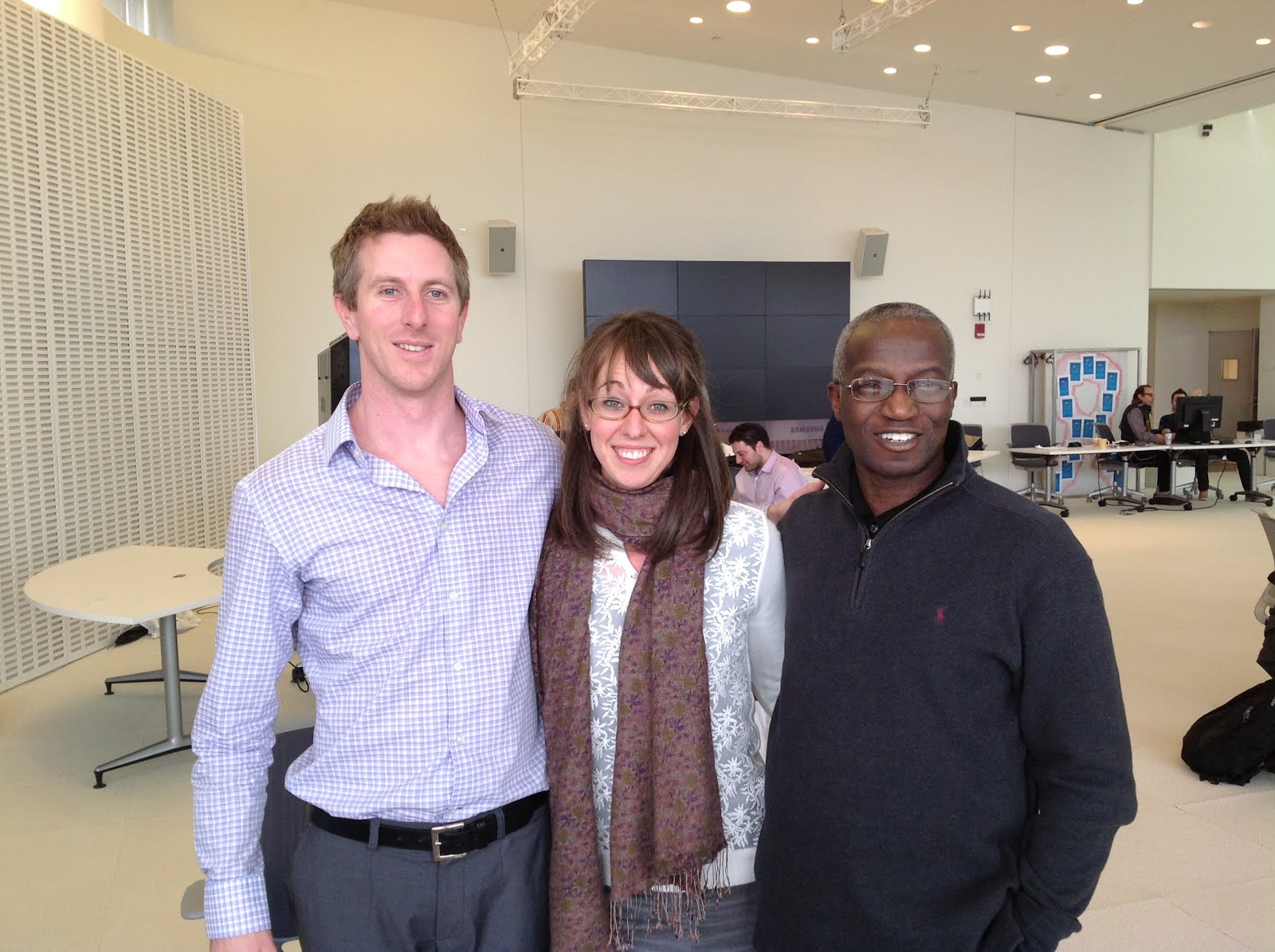
From left: Health & Wellness Innovation organizer and Media Lab PhD student John Moore, MD; Lindi van Niekerk, MD; and Media Lab research affiliate Julius Akinyemi.
For two weeks, I was able to surround myself with passionate innovators who worked in six project teams to address health challenges like HIV, epilepsy, hypertension, endometriosis, Parkinson’s, and cardiac failure. These teams pushed toward new frontiers in patient empowerment. In all health systems, we need to realise that our patients are competent interpreters of their own lives and that our role as innovators is to support them with the best means to do so.
I joined a group of experts developing a mobile application to support HIV patients in managing their disease, a project well-suited to a priority need in South Africa. This diverse team of clinicians, software developers, biomedical engineers, health literacy experts, and behaviour-change experts had a range of knowledge and backgrounds that worked to catalyse innovation. The first few days allowed for a wonderfully messy and creative process of sharing new and fresh ideas on how patients can be supported with medication adherence. After exploring broadly, we were able to focus on the core components and got started on developing a prototype. From animated videos providing educational insights, to screen designs targeted at both patients and providers, to an incorporated point of care test, the HIVIVA application emerged.
The product outcomes of such an innovation process are, of course, a benefit of attending a two-week event like this–but the relationships that result are arguably as great a benefit. I had the opportunity to form friendships and connections with such special people, including my teammates and members of the extended MIT family.
My ability to attend the hackathon was made possible through the unique and exciting collaboration being established between MIT and the Bertha Centre for Social Innovation at the Graduate School of Business in Cape Town. In addition, the people of the MIT Media Lab–Julius Akinyemi, Joost Bonsen, and John Moore–gave value to my visit, as did my host Michele Oshima who kindly opened her home to me for two weeks.
I departed MIT more excited than ever and filled with new enthusiasm to take the innovation process back to Cape Town. I look forward to creating a stimulating and enabling environment for our local innovators and entrepreneurs to uncover novel solutions to improve healthcare for our patients who need it most.
Wednesday, January 9, 2013
Please Welcome Our New Director's Fellows
Everywhere I travel, I meet people who are doing groundbreaking, game-changing work in the most creative and innovative ways, from learning and education, to art and music, to activism, to sports, science, and film--and everything in between! There are people all over the world with less-than-traditional backgrounds (like me!) who would be great additions to the Media Lab community. We wanted to create a program to loop them in.
Our new Director's Fellows initiative creates a way for these extraordinary individuals to take part in Media Lab research alongside our faculty and students. We're bringing a cohort of characters from a broad range of sectors and geographies to join us in doing collaborative research and to expand our growing global community. The fellows will not only work with the Lab's students and faculty, but also with each other.
The first group of fellows includes:
- Director/producer J. J. Abrams;
- Chess grandmaster Maurice Ashley;
- Fashion designer Christopher Bevans;
- Nairobi-based technologists/activists David Kobia and Juliana Rotich;
- Open education advocate Philipp Schmidt;
- Detroit community activist Shaka Senghor;
- Maker movement advocate Jeff Sturges; and
- Author and comedian Baratunde Thurston.
At the Media Lab, inventing the future is our focus. Moving forward, I believe a lot of that invention will come from sharing ideas and creating community. Over the past year or so, we’ve been working hard to come up with new, creative ways to do that. The fellows initiative is one way to open up the Lab up to the world, which will benefit both the fellows and the Lab community tremendously.
What all the fellows have in common is that they’re leaders in their fields, and that they embody the Lab's uniqueness, impact, and magic. They're also all passionate about collaborating with the Lab. You should never be able to guess who the next new fellow will be by looking at the current roster.
We’re really looking forward to the unexpected twists and turns these collaborations will take. Stay tuned!
P.S. A few people have mentioned that there is only one woman in the first cohort. We'll have a much better balance when we add the next batch.
Joi Ito is Director of the MIT Media Lab.
Monday, December 10, 2012
IG Detroit by Shaka Senghor
When we started planning a visit and project in Detroit earlier this year, we had only a few rough ideas of what to expect—and we ended up with every expectation challenged. We went to help, and ended up learning more than teaching. We want to keep working with our new friends and collaborators there, and we are continuing to discuss how and when to do this.
One of the people we met through the Innovators Guild Detroit project was Shaka Senghor. I won't go into his bio here, but if you Google him you'll see that his story is an amazing and inspiring one. He's also an awesome writer, and has written up some of his thoughts and impressions about the IG Detroit event. We wanted to share them with you so you could get a sense of what a non-Media Lab participant felt about the project. I look forward to your comments. —Joi
We looked more like a rock band than a band of innovators as we hustled into the large shiny black SUV. White, black, Asian, short, tall, casually dressed, it was all there–the only things missing were guitars, amps, a bass, and a dope lead vocalist. But we were no band–in fact we had yet to band together around the task at hand–and in essence this first ride through the gritty streets of Detroit would be our feeling-out period. We were getting to know each other against the backdrop of a city that had been labeled the rust belt capital or murder capital of the world depending on who was telling the story.
I felt a great deal of responsibility as an ambassador of Detroit. I knew that I had to show the complexities of Detroit if we were to succeed in our efforts as innovators. I didn’t want anyone to come away from IG Detroit with an unrealistic, romanticized idea of the challenges we face. As we made our way down Grand River Avenue, the stark contrast of poverty-entrenched communities that were only a few blocks away from wealthy enclaves was evident. By highlighting these contradictions I felt that the team members would be better equipped to understand how to approach the design challenges.
We drove block after burned out block and I watched the varied expressions of my passengers through the rear-view mirror. They ranged from disbelief and sadness, to intrigue and hopefulness. In my own eyes I saw a tinge of embarrassment for our city, for the people who call Detroit home, including myself. For the first time in a long time I looked at Detroit objectively, and it was painful to digest what was happening to my beloved city. However the pain was soothed by thoughts of what was underway.
As we traveled around Detroit, I felt compelled to give a voice to the societal fractures all around us, but where was I to begin? How could I sum up the tearing asunder of a city that at one time was a place of pride and joy? There was no easy answer and the gravity of it bore down on me. So instead, I simply said there is so much hope and potential here, and it was these simple words that set the tone for what I hoped IG Detroit would mean for that weekend. Though we had yet to sit down in our work space, I could see the wheels of innovation starting to spin.
Personally, this was one of the most exciting and rewarding experiences I have had. Being able to work with such humble, giving, thoughtful, and highly motivated people turned out to be the highlight of my weekend. The synergy of urban dwellers, tech geeks, authors, clothing designers, and design innovators proved my long-held belief that you see the best of humanity when artificial barriers are replaced by real-life experiences. The creative energy and inspiring spirits were contagious and brought our projects full circle. Over the course of what turned out to be a four-day weekend we tackled the following challenges:
- DIY Lighting: Solutions that help citizens create outdoor lighting
- Digital Community: Online infrastructure for connecting—offline and in-person
- Air Monitoring: Citizen-powered systems for monitoring and reporting air quality
- DIY Soil Safety: Creating ways for ordinary citizens to better understand their soil
- Compost Rotation: Developing solutions for scalable urban agriculture
We worked in small groups dispersed throughout OmniCorp, located in the heart of Detroit’s Eastern Market. Each group had its own space to iterate on ideas that were shared at the inception of IG Detroit, but we all checked in on each other from time to time. We genuinely enjoyed each other’s company and had a blast each night when we wound down from our work day.

Digital Community team: Fame Brown, Erhardt Graeff, Haiyan Zhang, Shaka Senghor, Christina Xu, Tara Brown
When it was time to conclude our weekend and share our projects I had mixed feelings. On the one hand, I was very excited to see what innovations the other teams came up with, but on the other hand, I was a bit saddened that our weekend was coming to an end. I had made friends with people who I believe will be a part of my life for years to come. I had laughed and joked with designer Christopher Bevans and shared soul food with Haiyan Zhang and Erhardt Graeff. In addition to innovating we were creating a human experience that will have a lasting impact for years to come.
After we presented in front of the other groups and people from different areas of Detroit, I took time to talk to those in attendance to get a feel for what they thought. From what I gathered from talking with people who showed up on the final day, there is a great deal of hope and optimism about the future of IG Detroit. I could even sense from those who were cynical in the beginning that they were impressed by what we were able to accomplish in a relatively short amount of time. They were excited by our work and showed interest in working with us moving forward. It was a good sign that we are on the right path and I am looking forward to the next phase of IG Detroit.
Shaka Senghor is a community activist and writer based in Detroit, Michigan. He is the recipient of the Knight Foundation's BME Leadership Award. Follow him on Twitter: @ShakaSenghor
IG Detroit was supported by a grant from Knight Foundation.
Tuesday, November 20, 2012
Encouraging Innovation in Sierra Leone

Kelvin Doe (left) and David Sengeh at the Media Lab. Learn more about Kelvin. (Photo: Paula Aguilera)
At the Media Lab, PhD candidate David Sengeh is helping to change the world by developing next-generation smart prostheses. But this self-professed technology geek is also making an impact halfway around the world in his native Sierra Leone, where he’s launched Innovate Salone, a national high-school innovation challenge. Innovate Salone is funded by Global Minimum Inc.. “The idea,” says David, “is to encourage the country’s students to use their own ingenuity to solve some of their country’s most challenging problems–to lay the bedrock for national development.” The focus is on issues related to health, energy, education, agriculture, transportation, telecommunications, civic media, and engineering.
Read what David says about the project on CNN. [Update: here's another article, with a great video of David and Kelvin working at the Media Lab.] Interested in becoming a sponsors or donor? Send email to info@gmin.org.
Friday, November 16, 2012
Making Connections @ MozFest 2012
Is it even possible to describe the beautiful maelstrom of joy and creativity we experienced at the Mozilla Festival last weekend? Three days of learning, design, and making across nine floors at Ravensbourne University left me feeling like I had fallen into a ball pit overflowing with magic beans from Jack and the Giant Beanstalk. Creative ideas were growing fast in all directions.
At the same time, the festival offered fascinating insights into how Mozilla facilitates their amazing community energy around transformational change towards an open Internet of makers.
Our Part in the Mozilla FestivalAt the festival, the Media Lab's Lifelong Kindergarten group offered a variety of sessions on creative learning:
- Ricarose Roque has blogged about the session she led: a discussion about Designing Creative Technology Playgrounds for Families
- Mitchel Resnick and the team from Lifelong Kindergarten led a session on Scratch 2.0 (Becca and Amira from DigitalMe's youth team made an awesome video report about Scratch at Mozfest)
- Champika Fernando led a learning lab about connecting Mozilla Thimble and Scratch to program web pages
- Sayamindu Dasgupta showed of his work on Maps and Cloud Data for Scratch
- Eric Rosenbaum held a workshop on MaKey MaKey. Ravensbourne student Selcuk Cura has uploaded videos of what people created ( 1, 2, 3, 4, 5, 6).
The Mozilla Festival also brings together a community of bloggers, journalists, and documentary film-makers to share idea and collaborate.
- I facilitated an amazing conversation of journalists, film-makers, coders, and activists on citizen video. Check out the extensive notes and links on the Civic Media blog: Curating and Repackaging Citizen Video for the News at #MozFest.
- The Knight Foundation, who funds the Center for Civic Media, announced the 2013 Knight-Mozilla Open News Fellows and discussed new directions for Knight's grantmaking in digital innovation for the news.
During the festival, I enjoyed liveblogging with the Mozilla team, finding out what young people made during the festival, and documenting Joi's keynote on Sunday. The high point for me was an amazing team effort with Matt, Rebecca, Paul and others to photograph and document every project during the festival's closing Demo Party. Inspiring!
I want to especially thank Gunner and Michelle Thorne for running a truly wonderful event, and for offering ongoing, supportive advice on how to facilitate great sessions.
Organizations as Networks
Mozilla is one of the organizations I point to when I talk about what it means to be a network and a platform rather than just an institution. To illustrate what I mean, consider the story of PopcornMaker, a video editor for the open web.
During the Sunday morning plenary, Brett Gaylor told the story of Popcorn.js, which started as a college student project. It has now been used in high-profile productions such as NFB’s One Millionth Tower, PBS and NPR’s 2012 election coverage, and more. In 2011, the creators of Popcorn.js brought it to the very first Mozilla Festival. A year later, they came to London to premiere One Millionth Tower. Now in 2012, PopcornMaker opens up open video creation to anyone on the web. Here's their story:
This year, I'm taking away three big lessons from Mozilla and PopcornMaker:
- Networked organizations facilitate moments for innovation to arrive from the edges to meet the inspiration and connections to succeed. At #MozFest 2011, the popcorn.js developers found film-making partners to develop projects like One Millionth Tower.
- Networked organizations offer innovators the structure they need to build and ship good products. In addition to connections, Mozilla supported Popcorn through bug tracking, a release schedule, and publicity to turn a great idea into a solid technology.
- Platforms turn great hacks into visionary, transformational paradigms. Popcorn.js was a library for software developers. By creating PopcornMaker, Mozilla is extending its vision for an open, writeable web to video online for anyone.
Further Links:
- #MozFest photos on Flickr (Mozilla's favorites: here and here)
- Rob Hammond's thorough Mozilla Festival Roundup post (and bookmarks)
- "My Mozfest" by Emma Irwin
- Open Knowledge Foundation's Data Journalism Expeditions
- A reflection on sustainability and open technology by Janet Gunter
- (add yours in the comments!)
J. Nathan Matias is a graduate student researching media consumption, creative learning, and community co-design at the Center for Civic Media.
Friday, November 2, 2012
Hurricane Hackers @ Media Lab
This post by Media Lab Director Joi Ito originally ran on LinkedIn's Thought Leaders blog.
What do you get when you have a massive storm approaching, a bunch of MIT Media Lab hackers with the next day off stuck in their rooms waiting for the power to go out? You get #hurricanehackers of course.
We learned a lot about this during the Safecast launch after the 3/11 earthquake in Japan, and are seeing it now with #hurricanehackers.
One of the most important principles of what we do at the Media Lab is "practice over theory" or "just build it". It's a very effective principle in rapid response to natural disasters and other things where the ability to "pull" from the network and collaborate quickly and effectively are essential. One of the key elements is to make sure that you use all of the effective tools for collaboration and communication so that you don't duplicate efforts and you quickly aggregate and pull people together. Most of the obvious ideas get started by everyone and trying to find unique ideas while pulling together parallel projects is key.
One thing we quickly learned is that tools like Google docs and etherpad with their limit on the total number of participants were inadequate for the scale of collaboration we need. We ended up on Internet Relay Chat (IRC), the pre-Web text chat protocol that survives today as one of the primary modes of communication among hackers.
We'll be hosting one of the number of CrisisCamps this weekend at the Media Lab. Please tune in or participate if you have time.
#hurricanehackers in Wired, Boing Boing, BostonInno
Monday, October 8, 2012
IG: Detroit Update
After a few days here in Detroit, the groups have made amazing progress on their challenges. The challenges were:
CHALLENGES
- DIY Lighting: Solutions that help citizens create outdoor lighting
- Digital Community: Online infrastructure for connecting—offline and in-person
- Air Monitoring: Citizen-powered systems for monitoring and reporting air quality
- DIY Soil Safety: Creating ways for ordinary citizens to better understand their soil
- Compost Rotation: Developing solutions for scalable urban agriculture
We'll roll out more details about each team's work over the next few weeks, but here's a preview.


Within a few hours of beginning our challenges, the air testing team (above) strapped a particulate sensor to a laptop and took it out to grab samples and talk to local residents about air monitoring. Their conversations revealed that there's a wide spectrum of perceptions about air and air quality. Their ultimate goal is to provide citizens with ways to regain agency over their air. Inspired by Detroit's vibrant graffiti culture, they have identified opportunities for both data collection and creative expression that make the invisible visible, via tools both to collect data and "tag" pollution.

The lighting team, (De)Constructing Light, (above) discovered through talking to residents that light and community are closely related. Without communication, a neighborhood is just a neighborhood; light is a pure form of communication that helps us form community and make connections. Offering people ways to reshape and personalize the things they care about and use every day makes them care about those things more. Educating residents about what's possible was an important first step, and more important than actually building a perfect light.
In a workshop on Sunday at the Mt. Elliott Makerspace, the team showed a group of kids that finished objects are not always finished—we can take things apart and reuse them in different, and sometimes more useful, ways. They led the workshop through a project that involved taking apart and re-imagining a flashlight, teaching participants that disassembling an object can be a metaphor for empowerment.



The compost team, Black Gold, (above) is educating and enabling people about home worm composting. They're also making available a community-wide composting system. The team decided use worms for a few reasons: they create usable compost as much as six times faster than aerobic composting, and they generate higher-quality compost; in addition, using worms for composting eliminates the need to flip compost, one of the more labor-intensive and difficult aspects of aerobic composting. Finally, the worms self-perpetuate, so they can be shared with friends and neighbors indefinitely.


The community team (above) is creating a network of billboards and interactive in-store displays in community hubs around Detroit, the Detroit Digital Board or D-board. The D-board will allow for richer information sharing within and across communities, by showcasing local events, community resources, and positive messages in public spaces. This project will allow Detroiters to inform themselves, changing the urban environment by conveying positive, community-focused information.


The soil team (above) has created CitySoil: Detroit, a three-part plan to engage, educate, and share information about how to test soil and improve soil performance. They're working on ways to educate residents about what questions to ask about their soil; how to test the soil and what to look for in the results; and how to share this information with neighbors and other residents through tools like interactive maps and data visualizations.
Subscribe to:
Posts (Atom)