Monday, December 10, 2012

IG Detroit by Shaka Senghor

When we started planning a visit and project in Detroit earlier this year, we had only a few rough ideas of what to expect—and we ended up with every expectation challenged. We went to help, and ended up learning more than teaching. We want to keep working with our new friends and collaborators there, and we are continuing to discuss how and when to do this.

One of the people we met through the Innovators Guild Detroit project was Shaka Senghor. I won't go into his bio here, but if you Google him you'll see that his story is an amazing and inspiring one. He's also an awesome writer, and has written up some of his thoughts and impressions about the IG Detroit event. We wanted to share them with you so you could get a sense of what a non-Media Lab participant felt about the project. I look forward to your comments. —Joi


We looked more like a rock band than a band of innovators as we hustled into the large shiny black SUV. White, black, Asian, short, tall, casually dressed, it was all there–the only things missing were guitars, amps, a bass, and a dope lead vocalist. But we were no band–in fact we had yet to band together around the task at hand–and in essence this first ride through the gritty streets of Detroit would be our feeling-out period. We were getting to know each other against the backdrop of a city that had been labeled the rust belt capital or murder capital of the world depending on who was telling the story.

I felt a great deal of responsibility as an ambassador of Detroit. I knew that I had to show the complexities of Detroit if we were to succeed in our efforts as innovators. I didn’t want anyone to come away from IG Detroit with an unrealistic, romanticized idea of the challenges we face. As we made our way down Grand River Avenue, the stark contrast of poverty-entrenched communities that were only a few blocks away from wealthy enclaves was evident. By highlighting these contradictions I felt that the team members would be better equipped to understand how to approach the design challenges.

We drove block after burned out block and I watched the varied expressions of my passengers through the rear-view mirror. They ranged from disbelief and sadness, to intrigue and hopefulness. In my own eyes I saw a tinge of embarrassment for our city, for the people who call Detroit home, including myself. For the first time in a long time I looked at Detroit objectively, and it was painful to digest what was happening to my beloved city. However the pain was soothed by thoughts of what was underway.

As we traveled around Detroit, I felt compelled to give a voice to the societal fractures all around us, but where was I to begin? How could I sum up the tearing asunder of a city that at one time was a place of pride and joy? There was no easy answer and the gravity of it bore down on me. So instead, I simply said there is so much hope and potential here, and it was these simple words that set the tone for what I hoped IG Detroit would mean for that weekend. Though we had yet to sit down in our work space, I could see the wheels of innovation starting to spin.

Personally, this was one of the most exciting and rewarding experiences I have had. Being able to work with such humble, giving, thoughtful, and highly motivated people turned out to be the highlight of my weekend. The synergy of urban dwellers, tech geeks, authors, clothing designers, and design innovators proved my long-held belief that you see the best of humanity when artificial barriers are replaced by real-life experiences. The creative energy and inspiring spirits were contagious and brought our projects full circle. Over the course of what turned out to be a four-day weekend we tackled the following challenges:

  • DIY Lighting: Solutions that help citizens create outdoor lighting
  • Digital Community: Online infrastructure for connecting—offline and in-person
  • Air Monitoring: Citizen-powered systems for monitoring and reporting air quality
  • DIY Soil Safety: Creating ways for ordinary citizens to better understand their soil
  • Compost Rotation: Developing solutions for scalable urban agriculture

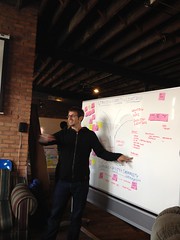
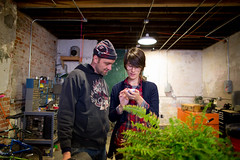
We worked in small groups dispersed throughout OmniCorp, located in the heart of Detroit’s Eastern Market. Each group had its own space to iterate on ideas that were shared at the inception of IG Detroit, but we all checked in on each other from time to time. We genuinely enjoyed each other’s company and had a blast each night when we wound down from our work day.


Digital Community team: Fame Brown, Erhardt Graeff, Haiyan Zhang, Shaka Senghor, Christina Xu, Tara Brown

When it was time to conclude our weekend and share our projects I had mixed feelings. On the one hand, I was very excited to see what innovations the other teams came up with, but on the other hand, I was a bit saddened that our weekend was coming to an end. I had made friends with people who I believe will be a part of my life for years to come. I had laughed and joked with designer Christopher Bevans and shared soul food with Haiyan Zhang and Erhardt Graeff. In addition to innovating we were creating a human experience that will have a lasting impact for years to come.

After we presented in front of the other groups and people from different areas of Detroit, I took time to talk to those in attendance to get a feel for what they thought. From what I gathered from talking with people who showed up on the final day, there is a great deal of hope and optimism about the future of IG Detroit. I could even sense from those who were cynical in the beginning that they were impressed by what we were able to accomplish in a relatively short amount of time. They were excited by our work and showed interest in working with us moving forward. It was a good sign that we are on the right path and I am looking forward to the next phase of IG Detroit.


Shaka Senghor is a community activist and writer based in Detroit, Michigan. He is the recipient of the Knight Foundation's BME Leadership Award. Follow him on Twitter: @ShakaSenghor

IG Detroit was supported by a grant from Knight Foundation.

Tuesday, November 20, 2012

Encouraging Innovation in Sierra Leone

Kelvin Doe (left) and David Sengeh at the Media Lab. Learn more about Kelvin. (Photo: Paula Aguilera)

At the Media Lab, PhD candidate David Sengeh is helping to change the world by developing next-generation smart prostheses. But this self-professed technology geek is also making an impact halfway around the world in his native Sierra Leone, where he’s launched Innovate Salone, a national high-school innovation challenge. Innovate Salone is funded by Global Minimum Inc.. “The idea,” says David, “is to encourage the country’s students to use their own ingenuity to solve some of their country’s most challenging problems–to lay the bedrock for national development.” The focus is on issues related to health, energy, education, agriculture, transportation, telecommunications, civic media, and engineering.

Read what David says about the project on CNN. [Update: here's another article, with a great video of David and Kelvin working at the Media Lab.] Interested in becoming a sponsors or donor? Send email to info@gmin.org.

Friday, November 16, 2012

Making Connections @ MozFest 2012

Is it even possible to describe the beautiful maelstrom of joy and creativity we experienced at the Mozilla Festival last weekend?  Three days of learning, design, and making across nine floors at Ravensbourne University left me feeling like I had fallen into a ball pit overflowing with magic beans from Jack and the Giant Beanstalk. Creative ideas were growing fast in all directions.

At the same time, the festival offered fascinating insights into how Mozilla facilitates their amazing community energy around transformational change towards an open Internet of makers.

Our Part in the Mozilla Festival

At the festival, the Media Lab's Lifelong Kindergarten group offered a variety of sessions on creative learning:

The Mozilla Festival also brings together a community of bloggers, journalists, and documentary film-makers to share idea and collaborate.

During the festival, I enjoyed liveblogging with the Mozilla team, finding out what young people made during the festival, and documenting Joi's keynote on Sunday. The high point for me was an amazing team effort with Matt, Rebecca, Paul and others to photograph and document every project during the festival's closing Demo Party. Inspiring!

I want to especially thank Gunner and Michelle Thorne for running a truly wonderful event, and for offering ongoing, supportive advice on how to facilitate great sessions.

Organizations as Networks
Mozilla is one of the organizations I point to when I talk about what it means to be a network and a platform rather than just an institution. To illustrate what I mean, consider the story of PopcornMaker, a video editor for the open web.

During the Sunday morning plenary, Brett Gaylor told the story of Popcorn.js, which started as a college student project. It has now been used in high-profile productions such as NFB’s One Millionth Tower, PBS and NPR’s 2012 election coverage, and more. In 2011, the creators of Popcorn.js brought it to the very first Mozilla Festival. A year later, they came to London to premiere One Millionth Tower. Now in 2012, PopcornMaker opens up open video creation to anyone on the web. Here's their story:

This year, I'm taking away three big lessons from Mozilla and PopcornMaker:

  • Networked organizations facilitate moments for innovation to arrive from the edges to meet the inspiration and connections to succeed. At #MozFest 2011, the popcorn.js developers found film-making partners to develop projects like One Millionth Tower.
  • Networked organizations offer innovators the structure they need to build and ship good products. In addition to connections, Mozilla supported Popcorn through bug tracking, a release schedule, and publicity to turn a great idea into a solid technology.
  • Platforms turn great hacks into visionary, transformational paradigms. Popcorn.js was a library for software developers. By creating PopcornMaker, Mozilla is extending its vision for an open, writeable web to video online for anyone.
As a grad student at the Media Lab, where Joi is re-imagining the Lab as a network, I'm excited to share inspiration and collaboration with such an amazing community. In all the creative unpredictability of the #MozFest's bag of magic beans, I think we're going to see some very tall trees grow.

Further Links:


J. Nathan Matias is a graduate student researching media consumption, creative learning, and community co-design at the Center for Civic Media.

Friday, November 2, 2012

Hurricane Hackers @ Media Lab

This post by Media Lab Director Joi Ito originally ran on LinkedIn's Thought Leaders blog.

What do you get when you have a massive storm approaching, a bunch of MIT Media Lab hackers with the next day off stuck in their rooms waiting for the power to go out? You get #hurricanehackers of course.

We learned a lot about this during the Safecast launch after the 3/11 earthquake in Japan, and are seeing it now with #hurricanehackers.

One of the most important principles of what we do at the Media Lab is "practice over theory" or "just build it". It's a very effective principle in rapid response to natural disasters and other things where the ability to "pull" from the network and collaborate quickly and effectively are essential. One of the key elements is to make sure that you use all of the effective tools for collaboration and communication so that you don't duplicate efforts and you quickly aggregate and pull people together. Most of the obvious ideas get started by everyone and trying to find unique ideas while pulling together parallel projects is key.

One thing we quickly learned is that tools like Google docs and etherpad with their limit on the total number of participants were inadequate for the scale of collaboration we need. We ended up on Internet Relay Chat (IRC), the pre-Web text chat protocol that survives today as one of the primary modes of communication among hackers.

We'll be hosting one of the number of CrisisCamps this weekend at the Media Lab. Please tune in or participate if you have time.

#hurricanehackers in Wired, Boing Boing, BostonInno

Monday, October 8, 2012

IG: Detroit Update

After a few days here in Detroit, the groups have made amazing progress on their challenges. The challenges were:

CHALLENGES

  • DIY Lighting: Solutions that help citizens create outdoor lighting
  • Digital Community: Online infrastructure for connecting—offline and in-person
  • Air Monitoring: Citizen-powered systems for monitoring and reporting air quality
  • DIY Soil Safety: Creating ways for ordinary citizens to better understand their soil
  • Compost Rotation: Developing solutions for scalable urban agriculture

We'll roll out more details about each team's work over the next few weeks, but here's a preview.

Air Monitoring Talking about air monitoring

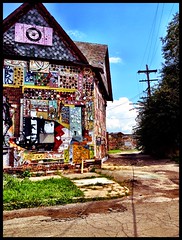
Within a few hours of beginning our challenges, the air testing team (above) strapped a particulate sensor to a laptop and took it out to grab samples and talk to local residents about air monitoring. Their conversations revealed that there's a wide spectrum of perceptions about air and air quality. Their ultimate goal is to provide citizens with ways to regain agency over their air. Inspired by Detroit's vibrant graffiti culture, they have identified opportunities for both data collection and creative expression that make the invisible visible, via tools both to collect data and "tag" pollution.

1980-01-01 00.00.09-2 photo(15)

The lighting team, (De)Constructing Light, (above) discovered through talking to residents that light and community are closely related. Without communication, a neighborhood is just a neighborhood; light is a pure form of communication that helps us form community and make connections. Offering people ways to reshape and personalize the things they care about and use every day makes them care about those things more. Educating residents about what's possible was an important first step, and more important than actually building a perfect light.

In a workshop on Sunday at the Mt. Elliott Makerspace, the team showed a group of kids that finished objects are not always finished—we can take things apart and reuse them in different, and sometimes more useful, ways. They led the workshop through a project that involved taking apart and re-imagining a flashlight, teaching participants that disassembling an object can be a metaphor for empowerment.

Compost team Team Compost Joe and Nadya David Mellis

The compost team, Black Gold, (above) is educating and enabling people about home worm composting. They're also making available a community-wide composting system. The team decided use worms for a few reasons: they create usable compost as much as six times faster than aerobic composting, and they generate higher-quality compost; in addition, using worms for composting eliminates the need to flip compost, one of the more labor-intensive and difficult aspects of aerobic composting. Finally, the worms self-perpetuate, so they can be shared with friends and neighbors indefinitely.

Community team Detroit Digital Board

The community team (above) is creating a network of billboards and interactive in-store displays in community hubs around Detroit, the Detroit Digital Board or D-board. The D-board will allow for richer information sharing within and across communities, by showcasing local events, community resources, and positive messages in public spaces. This project will allow Detroiters to inform themselves, changing the urban environment by conveying positive, community-focused information.

Soil samples CitySoil:Detroit

The soil team (above) has created CitySoil: Detroit, a three-part plan to engage, educate, and share information about how to test soil and improve soil performance. They're working on ways to educate residents about what questions to ask about their soil; how to test the soil and what to look for in the results; and how to share this information with neighbors and other residents through tools like interactive maps and data visualizations.

Monday, September 24, 2012

Detroit Pre-Trip Report

This summer we started talking about forming a group for innovators, and decided to begin the initiative with a hands-on project in Detroit. We knew that things would grow and change, and that we'd need to be agile and flexible (two qualities important to fostering innovation). Members of the Media Lab team have made a few trips to Detroit, and a group of Detroiters came here to the Lab to see what we're about on our home turf.

This event has changed from what we'd originally envisioned, and we're glad of that—we think that now it more accurately reflects the kind of work already being done in Detroit, as well as plays to the strengths of the Lab and our member company and event co-producer IDEO.

Detroit

This work builds upon Knight Foundation's already existing commitment to foster information sharing and engagement in Detroit communities. Together, the Media Lab, IDEO, and Knight are excited to work on a series of design challenges with a mix of the Lab’s own special alchemical blend of uniqueness, impact, and magic.

So what's next? We're heading back to Detroit October 5-8 for our first meeting, and to get things started we brainstormed with and listened to our new Detroit friends to come up with a few starting-off points that fit with the needs and concerns in their communities. We framed some challenges that will, we hope, empower all of us and create community.

CHALLENGES

  • DIY Lighting: Solutions that help citizens create outdoor lighting
  • Digital Community: Online infrastructure for connecting—offline and in-person
  • Air Monitoring: Citizen-powered systems for monitoring and reporting air quality
  • DIY Soil Safety: Creating ways for ordinary citizens to better understand their soil
  • Compost Rotation: Developing solutions for scalable urban agriculture

We'll have one team per challenge, with each team made up of Detroiters + Media Labbers + IDEO designers + expert friends + industry innovators. We envision the challenges as jumping-off points for the teams. Some might end up with a totally different result than the challenge, but the important thing is to look, listen, and learn from our surroundings and collaborators.

We'll all be blogging, tweeting, and posting while we're in Detroit and after we get home, so that others can see what we're working on, meet our Detroit collaborators, and join the conversation. Our hashtag will be #IGDetroit.

We’ll check back in again with a blog post before we head to Detroit, to share more details about some of the team members.

Thursday, August 30, 2012

The Media Lab through Your Lens: Enter Our Photo Contest and Meet Joi Ito!

The Media Lab’s reach spans the entire globe thanks to our professors, students, alumni, and spin-off companies. We’re always excited to see our researchers developing technologies that promise to fundamentally transform our most basic notions of human capabilities. To celebrate the many projects that come out of the Media Lab, we present The Media Lab through Your Lens photo contest.

We’re looking for examples of the Media Lab in the world–through your pictures. All you have to do is snap a photo of anything that relates back to the Media Lab–for example, a Media Lab professor giving a presentation at an event, a mobile app developed at the Media Lab, or a technology or product developed by Lab researchers. We’ll leave it to you to be as literal or creative as you wish. The picture just has to tie back to the Media Lab. Here are the rules:

  • Who can enter? Anyone who is not connected to the Media Lab (past or present).
  • What’s the timing? The contest begins today, and will end on September 10 17, 2012. [We're giving you an extra week! We've received some terrific entries so far and can't wait to see what else we get!]
  • How do I enter? Send your photo(s) to contest [at] media.mit.edu and you’ll be entered, pending your photo’s adherence to the rules. We encourage you to send as many pictures as you like, but your name will only be entered once. Make sure to include your full name and email address, and how you would like the photo to be credited.
  • What does the winner receive? If you submission meets the contest rules, you will automatically be entered into a drawing for a chance to win a tour of the Media Lab and lunch or dinner with Media Lab Director Joi Ito. (Note: you will need to provide your own transportation to Cambridge, MA.)

So what are you waiting for? Grab your camera, smartphone, or tablet and start sending us photos! You can check out our Facebook and Pinterest pages periodically throughout the contest to see a collection of the photos submitted.

We can’t wait to see the Media Lab through your eyes!


*All photos submitted for the contest become property of the Media Lab and as such can be distributed via Media Lab web pages and social channels. The MIT Media Lab has the right to disqualify any entrants submitting pictures that do not meet the guidelines or are stolen property.