Thursday, August 30, 2012

The Media Lab through Your Lens: Enter Our Photo Contest and Meet Joi Ito!

The Media Lab’s reach spans the entire globe thanks to our professors, students, alumni, and spin-off companies. We’re always excited to see our researchers developing technologies that promise to fundamentally transform our most basic notions of human capabilities. To celebrate the many projects that come out of the Media Lab, we present The Media Lab through Your Lens photo contest.

We’re looking for examples of the Media Lab in the world–through your pictures. All you have to do is snap a photo of anything that relates back to the Media Lab–for example, a Media Lab professor giving a presentation at an event, a mobile app developed at the Media Lab, or a technology or product developed by Lab researchers. We’ll leave it to you to be as literal or creative as you wish. The picture just has to tie back to the Media Lab. Here are the rules:

  • Who can enter? Anyone who is not connected to the Media Lab (past or present).
  • What’s the timing? The contest begins today, and will end on September 10 17, 2012. [We're giving you an extra week! We've received some terrific entries so far and can't wait to see what else we get!]
  • How do I enter? Send your photo(s) to contest [at] media.mit.edu and you’ll be entered, pending your photo’s adherence to the rules. We encourage you to send as many pictures as you like, but your name will only be entered once. Make sure to include your full name and email address, and how you would like the photo to be credited.
  • What does the winner receive? If you submission meets the contest rules, you will automatically be entered into a drawing for a chance to win a tour of the Media Lab and lunch or dinner with Media Lab Director Joi Ito. (Note: you will need to provide your own transportation to Cambridge, MA.)

So what are you waiting for? Grab your camera, smartphone, or tablet and start sending us photos! You can check out our Facebook and Pinterest pages periodically throughout the contest to see a collection of the photos submitted.

We can’t wait to see the Media Lab through your eyes!


*All photos submitted for the contest become property of the Media Lab and as such can be distributed via Media Lab web pages and social channels. The MIT Media Lab has the right to disqualify any entrants submitting pictures that do not meet the guidelines or are stolen property.

Wednesday, August 15, 2012

Technology and the Track

South African sprinter Oscar Pistorius just made history as the first double amputee to participate in the Olympic games, and the first amputee to take part in track events. Born without fibulae, Pistorius had his legs amputated below the knee before he was a year old.

Hugh Herr is an associate professor at the MIT Media Lab. An avid mountain climber, as a teenager he was caught in a blizzard while climbing in New Hampshire. After spending three nights outside in below-zero temperatures, he suffered severe frostbite and had to have both legs amputated below the knees. Not only did he walk again, he began climbing again using self-designed prostheses. [At left, Herr on the climbing wall at the Lab's h20 event. Photo: Webb Chappell]

Herr was an expert witness in the court case that resulted in the reversal of the ban preventing Oscar Pistorius from competing in the Olympics. We asked him a few questions about the science behind how Oscar runs.

What kinds of challenges does Oscar Pistorius have to overcome when racing with prosthetic legs?

Hugh Herr (HH): Oscar faces three dominant problems when racing with the Cheetah prosthesis. First, the Cheetah springs are passive, and therefore do not change stiffness during a running step. Consequently, Oscar's vertical ground forces are compromised, negatively impacting his running speed—that is, he can't push off the ground as hard, which reduces how fast he can run.

Second, Oscar's passive prostheses only return the energy that Oscar puts into them, actually less energy due to hysteresis. In contrast, the human ankle-foot complex is muscle powered and thus can propel a runner forward out of the running blocks during the acceleration phase of a race. Although the acceleration phase of the race has never been studied, it's likely that Oscar suffers from a lack of ankle power during this period of the race.

Finally, Oscar's prostheses are attached to his residual limb using a prosthetic socket that can often be uncomfortable and unstable. When Oscar sweats, his biological leg would become attached less securely to the artificial leg, possibly causing a degradation of performance.

How are ‘Cheetah blades’ different from other types of prosthetics? How do they work?

HH: The Cheetah prosthesis is designed specifically for running, and not for other activities such as walking. The Cheetah is shaped like a 'C' and is made from carbon composite, a highly elastic material for storing and releasing spring energy.

Do you think we’ll see other athletes like Oscar competing in the Olympic Games moving forward?

HH: Other persons with leg amputations may qualify for the Olympic games in the future, but it may be a very long time before another athlete is capable of qualifying. Oscar is a gifted and tenacious athlete.

Oscar Pistorius
Oscar Pistorius runs in the 2012 Summer Olympics. Photo: Paul Williams | CC BY-ND 2.0

What other kinds of prosthetics are being developed at the Media Lab?

HH: The Media Lab's Biomechatronics group designs computer-controlled bionic limbs for walking and running. A recent invention is a powered ankle-foot bionic limb that has been shown to normalize the biomechanics and energetics of walking. [At left, Herr with a variety of prototyped prosthetics. Photo: Webb Chappell]

Tuesday, August 7, 2012

Learning Through Connecting

Much of the discussion about educational technology these days focuses on new ways to deliver instruction, through online videos and online courses. In our Lifelong Kindergarten research group at the Media Lab, we have a very different approach to education and learning, developing technologies not to deliver instruction but to open opportunities for people to create, collaborate, experiment, and express themselves. With our Scratch programming software, for example, young people can create their own interactive stories, games, animations, and simulations, then share their creations with one another online. In the process, young people learn to think creatively, reason systematically, and work collaboratively – essential skills in today’s society.

Last week, we had an opportunity to see how this learning approach is taking root in different parts of the world, as we hosted our third Scratch@MIT conference. More than 400 educators, researchers, and developers from 31 countries came to the Media Lab for four days to share stories, plans, and visions about Scratch.

One unifying theme at the conference was the use of Scratch to encourage and support many different types of connections:

  • Connecting with ideas. In one of the keynote sessions, five educators and five third-grade students from a school district in New York demonstrated how they are using Scratch as part of a “computational thinking” curriculum unit, highlighting how programming activities can provide opportunities for students to engage with important math, science, and engineering ideas. Students weren’t just learning Scratch; they were learning with Scratch.

  • Connecting with interests. In session after session, it was clear that the best Scratch learning experiences happen when people have an opportunity to build on their own interests. There were examples of young people using Scratch to create simulations of environmental issues affecting their communities, games featuring characters from their favorite books, and animated stories with original soundtracks.

  • Connecting with the physical world. Increasingly, Scratch projects are stretching off the computer screen, connecting to sensors, motors, and other devices in the physical world. A researcher from Ireland demonstrated a way to use Microsoft Kinect to control Scratch projects with body gestures, while researchers from Japan introduced a low-cost sensor board for controlling Scratch projects.

  • Connecting with people. Many sessions at the conference highlighted the social nature of learning. Some presentations described how young people in different countries are collaborating on projects through the Scratch online community. Other presentations showed how educators are creating Scratch sub-communities within their countries.

Although the Scratch@MIT conference happens only once every two years, our research group is always working to nurture, sustain, and extend all of these connections. The ScratchEd website enables educators around the world to share stories, exchange resources, and connect with one another. And later this year, our group will launch a new generation of Scratch, called Scratch 2.0, that will enable people to create projects directly in the web browser, opening new opportunities for creativity and collaboration with Scratch.


Mitch Resnick is Professor of Learning Research and Director of the Lifelong Kindergarten research group at the MIT Media Lab.

Karen Brennan, a PhD student in the Lifelong Kindergarten group, chaired the organizing committee for the Scratch@MIT conference.

Thursday, July 26, 2012

Compasses Over Maps

At the Media Lab, I’ve been working on principles that define our DNA and our world view. One of these is Compasses Over Maps. The idea is that in a world of massive complexity, speed, and diversity, the cost of mapping and planning details often exceeds the cost of just doing something–and the maps are often wrong.

We experienced this firsthand during our trip to Detroit over the weekend.

In early July, we announced a new initiative: The Innovators Guild. Our idea was to bring the best and brightest chief innovation officers on a field trip to work together with our students, faculty, and local innovators in a community and do an impactful hackathon. The plan was to do a one-time thing in a bunch of cities around different themes. Detroit was the first on our list.

The general idea—the compass heading—was right, but the details were wrong in many ways.

We knew we had to go in to listen, be humble, and not try to be top down and prescriptive, but we were surprised nonetheless.

We met incredible people—smart, practical, passionate, driven, focused—doing amazing things. These people were tired of privileged “do gooders” coming in like tourists doing unsustainable superficial stuff and then just taking off or convening meetings and doing a lot of blah blah blah. “Are you here to blow smoke up our ass like everyone else?” There was a lot of baggage and they were skeptical, and rightly so. Detroit is “exciting” in many wrong ways to people who want to “help.”

But before we innovated on anything, we needed to listen and build trust. We realized immediately that to do that we had to think long term and in a sustainable way, while working closely with the people on the ground. This wouldn’t be just a three-day hackathon, but rather a long-term project connecting us to a network of networks in Detroit.

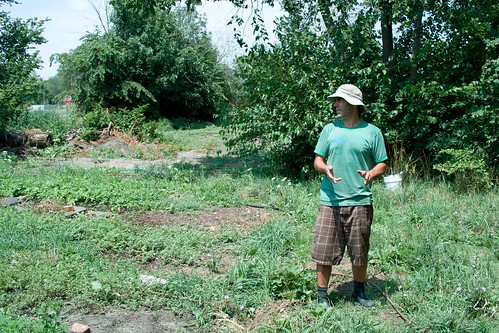
Urban Farm
Brother Nature Farm in Detroit | Joi Ito Photo | CC BY 2.0

We were amazed and humbled by the complexity of Detroit’s various networks, as well as their tensions and cohesion. Once we started making individual connections, we found that beneath the skepticism was a passion and cautious excitement. We discovered that there were definitely connections that could be cultivated into real relationships where we would learn, share, build, and grow together.

Greg
Greg of Brother Nature Farm | Joi Ito Photo | CC BY 2.0

One of these relationships is with Jeff Sturges, our guide on the ground in Detroit. Jeff runs the Mt. Elliott Makerspace in the basement of Church of the Messiah, and is just the first of many like-minded, creative individuals we anticipate inviting to the Media Lab as part of an ongoing collaboration.

We are super excited about the future of the Innovators Guild and our engagement in Detroit. And while our map was wrong, we listened and pivoted to this new plan, which I think is even more exciting. We returned to Boston completely energized and inspired, and can’t wait to go back to Detroit with more of our team to see what kind of work we can do with our new friends.


Joi Ito is director of the Media Lab.

Friday, July 13, 2012

Understanding the Global Rise of Citizen Media: Nairobi Trip Report

Witnessing the passionate enthusiasm of others is one of my great pleasures. The Center for Civic Media trip to Nairobi for the Global Voices Summit offered this delight in abundance. It has also given me a sober and urgent picture of the crucial importance of citizen media in society.

The summit was an amazing five-day gathering of bloggers, translators, and academics who care about blogs and citizen media around the world. For the first few days, as Global Voices working groups developed ideas for the future of their community, an academic conference organized by Zeynep Tufekci discussed the Internet and social change. After a day of rest and safari, we reconvened for a remarkable two-day conference, a public celebration and reflection on the promise and challenges of citizen media around the world.

Matt Stempeck and I were privileged to blog many of the public conversations:
Do also check out the Global Voices podcast on the summit by Jamillah Knowles.
IMG_0205 Academic Workshop #GV2012 "Elephant Plaza" at #GV2012 Global Voices Group Photo #GV2012 Untitled Coffe Break #GV2012
(Photos by the Global Voices community)

The trip to Nairobi has challenged me to rethink what it means to be a maker and an academic among journalists and activists. Before joining the Media Lab, I could rapidly jump into projects and causes with impunity. As a grad student, I move more slowly, seeking broader questions than the needs of the moment. This also happens with making as I filter my hunches for the ones that have broad relevance.

That's a good thing. One of the most amazing moments in the summit occurred during a joint gathering of the academics with the Global Voices community. After introducing ourselves, we asked the bloggers, activists, and translators to tell us what questions they think we should research. As I listened to their questions, I was moved by their passion and urgency. We academics can easily become distracted by the inside game of measuring our work by citation, remarking with a resigned sigh that the outside world is uninterested. The Global Voices community was telling us that they care deeply about the work that we do, and that we should focus on issues that matter to our world.

Making technology does open up special opportunities. Ethan sometimes jokes that Media Lab students communicate via the medium of the demo. At the Global Voices Summit, I did just that. I have been studying who gets quoted and whose voices are amplified most by the media. To learn from the Global Voices community, I developed a datavisualisation of social quotation on Global Voices and demoed it during the summit's Dataviz panel. Using the quantitative data as a starting point for conversation, I'm having fascinating discussions with the community.


In-between the conference, Ethan, Matt, and I also researched an open hardware idea we're playing with: a technology for energy-scarce settings that enables people to sell power to their neighbors. Ethan has written an extended, thought-provoking blog post about the experience.

We owe special thanks to iHub Research, who helped us find test devices and advised us on who to meet. Our friends at Pawa 254 helped us interview people in Baba Dogo, one of Nairobi's slum areas. Parallel to our work, Civic Media grad student Molly Sauter was also in Nairobi, interviewing people for our upcoming project on youth digital activism.

Like many of the Lab's students, I'm traveling this summer. Matt Stempeck is probably in a Matatu somewhere between Mombasa and the ancient Swahili city of Lamu. For now, I'm in London to work on my MS thesis. I'm also preparing to welcome our amazing crew of incoming students. Travel is fun, but there's no place like home. See you soon, Boston!

Tuesday, July 10, 2012

Zin-Side Out

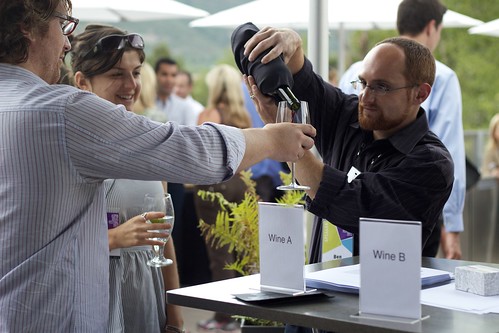
As part of the Media Lab's visit to the Aspen Ideas Festival, we designed a wine tasting experiment to showcase our technology and explore an important element of human behavior: the desire to conform to popular opinion.
At the Festival's mid-week reception, on a glorious rooftop deck with Rocky Mountain vistas, we set up three tables inviting attendees to taste a pair of red wines. Participants received a sheet describing wines A and B, tasted the wines sequentially (served from masked bottles), and then chose their favorite of the two, circling either A or B on the sheet.
Coco and Ben running the wine experiment
Coco Krumme and alum Ben Waber running the wine experiment.
Eric Rosenbaum photo, CC BY 2.0
IMG_20120630_180311
A participant samples one of the wines as Ben Waber and Coco Krumme look on.
Micah Eckhardt photo, CC BY 2.0
Our experiment was designed to test whether the perception that one wine was "preferred" or "special" would have an impact on an individual's preference. In addition to the (real) descriptive review of the wine, we added a fake "Robert Parker score" to each of the wines. For half of the participants, wine A had a score of 91 and B of 83; for the other half, this was reversed. In addition, the person pouring the wine emphasized the "specialness" of the wine with the higher score.
At two of the tables, we additionally tested the effect on electrodermal response of priming with the points information, using two sensors placed on the fingers to capture skin conductance. Through a software interface, we recorded response as well as "events" when a person sipped each wine.
Dan explains the wine experiment
Dan McDuff explains the experiment to several interested AIF attendees.
Eric Rosenbaum photo, CC BY 2.0
At the non-sensor table, participants were about evenly split between the two settings (A is promoted as higher ranked, versus B promoted). Using a chi-squared test, we found that people preferred A when it was emphasized at a statistically significant level (p ~ 0.01). However, when B was promoted as having the higher ranking, we didn't find any effect. This suggests that the belief that a wine is special may have an effect on people's preferences: but it also depends on the wine itself.
At the tables with sensors, we observed peaks in response when each wine was tasted, although there was no clear difference between tasting the promoted versus non-promoted wine.
In addition, we found curious scrawlings on several of the surveys, including cryptic arrows, heart shapes drawn around the preferred wine, equal signs indicating the (mistaken) belief that the two wines were the same. A couple of participants tried to argue with us that they had "figured out" the experiment: one person was adamant that we'd switched the descriptions for the wines.
In fact, each description correctly described the tasted wine, for both A and B throughout the experiment. Most people, after they'd tasted the wines, were curious about one thing: what were the wines? We can finally reveal the varietals and wineries: wine A was a Terrazas Reserva Malbec, and wine B a Ravenswood Old Vine Zinfandel.

Coco Krumme is a doctoral student at the MIT Media Lab in the Human Dynamics group.

Sunday, July 1, 2012

Innovating Innovation

Detroit Riverfront

Since I joined the Media Lab a year ago, I’ve been constantly amazed and amused by the tribe of iconoclasts, risk-takers, and renegades here who look to the edges for new ideas. On a walk through the Lab buildings, you'll see–among other things–robotic ankles, smart wallpaper, an interactive ping-pong table, fuzzy robots, and a model of a folding electric car. We call ourselves antidisciplinary, and we’d like to extend this way of thinking and working into a program we've named the Innovators Guild, aimed at bringing together like-minded trailblazers.

One thing I've noticed is that the people in organizations who are the most responsible for innovation are frequently working alone–and they're lonely. When you're the person who walks the tightrope between risk and results day in and day out, you need colleagues to bounce ideas off and peers to give a simple reality check: to tell you whether an idea is awesome–or simply crazy.

I'm envisioning the Innovators Guild as a cohort for CIOs and other innovators, a cross-sector network that can work together to make a challenging job a little less lonely, and a lot more fun.

We talked about the idea this morning at the Aspen Ideas Festival, and we’re still developing the details. As a first step, the Lab has teamed up with Knight Foundation (who will be filming a documentary of this project), and IDEO for our first hands-on activity, an on-the-ground project in Detroit, where we'll work with local innovators to hack out a new possible solution for inner-city food production and think about how to create sustainable systems. In the process, we expect to find new inspiration, make new connections, and engage in hands-on experiences to speed innovation. John Seely Brown, the former head of Xerox PARC and John Gage, former Chief Scientist of Sun Microsystems are the two first recruits for the guild who will be joining us on this trip.

We’ll be sharing more details about the Guild in the fall. Stay tuned!

[Interested in joining the Guild? Contact us at innovators-guild [at] media.mit.edu.]
Joi Ito is director of the Media Lab.

Image: "Detroit Riverfront" | Ian Freimuth | CC BY-NC-ND 2.0