Friday, November 16, 2012

Making Connections @ MozFest 2012

Is it even possible to describe the beautiful maelstrom of joy and creativity we experienced at the Mozilla Festival last weekend?  Three days of learning, design, and making across nine floors at Ravensbourne University left me feeling like I had fallen into a ball pit overflowing with magic beans from Jack and the Giant Beanstalk. Creative ideas were growing fast in all directions.

At the same time, the festival offered fascinating insights into how Mozilla facilitates their amazing community energy around transformational change towards an open Internet of makers.

Our Part in the Mozilla Festival

At the festival, the Media Lab's Lifelong Kindergarten group offered a variety of sessions on creative learning:

The Mozilla Festival also brings together a community of bloggers, journalists, and documentary film-makers to share idea and collaborate.

During the festival, I enjoyed liveblogging with the Mozilla team, finding out what young people made during the festival, and documenting Joi's keynote on Sunday. The high point for me was an amazing team effort with Matt, Rebecca, Paul and others to photograph and document every project during the festival's closing Demo Party. Inspiring!

I want to especially thank Gunner and Michelle Thorne for running a truly wonderful event, and for offering ongoing, supportive advice on how to facilitate great sessions.

Organizations as Networks
Mozilla is one of the organizations I point to when I talk about what it means to be a network and a platform rather than just an institution. To illustrate what I mean, consider the story of PopcornMaker, a video editor for the open web.

During the Sunday morning plenary, Brett Gaylor told the story of Popcorn.js, which started as a college student project. It has now been used in high-profile productions such as NFB’s One Millionth Tower, PBS and NPR’s 2012 election coverage, and more. In 2011, the creators of Popcorn.js brought it to the very first Mozilla Festival. A year later, they came to London to premiere One Millionth Tower. Now in 2012, PopcornMaker opens up open video creation to anyone on the web. Here's their story:

This year, I'm taking away three big lessons from Mozilla and PopcornMaker:

  • Networked organizations facilitate moments for innovation to arrive from the edges to meet the inspiration and connections to succeed. At #MozFest 2011, the popcorn.js developers found film-making partners to develop projects like One Millionth Tower.
  • Networked organizations offer innovators the structure they need to build and ship good products. In addition to connections, Mozilla supported Popcorn through bug tracking, a release schedule, and publicity to turn a great idea into a solid technology.
  • Platforms turn great hacks into visionary, transformational paradigms. Popcorn.js was a library for software developers. By creating PopcornMaker, Mozilla is extending its vision for an open, writeable web to video online for anyone.
As a grad student at the Media Lab, where Joi is re-imagining the Lab as a network, I'm excited to share inspiration and collaboration with such an amazing community. In all the creative unpredictability of the #MozFest's bag of magic beans, I think we're going to see some very tall trees grow.

Further Links:


J. Nathan Matias is a graduate student researching media consumption, creative learning, and community co-design at the Center for Civic Media.

Friday, November 2, 2012

Hurricane Hackers @ Media Lab

This post by Media Lab Director Joi Ito originally ran on LinkedIn's Thought Leaders blog.

What do you get when you have a massive storm approaching, a bunch of MIT Media Lab hackers with the next day off stuck in their rooms waiting for the power to go out? You get #hurricanehackers of course.

We learned a lot about this during the Safecast launch after the 3/11 earthquake in Japan, and are seeing it now with #hurricanehackers.

One of the most important principles of what we do at the Media Lab is "practice over theory" or "just build it". It's a very effective principle in rapid response to natural disasters and other things where the ability to "pull" from the network and collaborate quickly and effectively are essential. One of the key elements is to make sure that you use all of the effective tools for collaboration and communication so that you don't duplicate efforts and you quickly aggregate and pull people together. Most of the obvious ideas get started by everyone and trying to find unique ideas while pulling together parallel projects is key.

One thing we quickly learned is that tools like Google docs and etherpad with their limit on the total number of participants were inadequate for the scale of collaboration we need. We ended up on Internet Relay Chat (IRC), the pre-Web text chat protocol that survives today as one of the primary modes of communication among hackers.

We'll be hosting one of the number of CrisisCamps this weekend at the Media Lab. Please tune in or participate if you have time.

#hurricanehackers in Wired, Boing Boing, BostonInno

Monday, October 8, 2012

IG: Detroit Update

After a few days here in Detroit, the groups have made amazing progress on their challenges. The challenges were:

CHALLENGES

  • DIY Lighting: Solutions that help citizens create outdoor lighting
  • Digital Community: Online infrastructure for connecting—offline and in-person
  • Air Monitoring: Citizen-powered systems for monitoring and reporting air quality
  • DIY Soil Safety: Creating ways for ordinary citizens to better understand their soil
  • Compost Rotation: Developing solutions for scalable urban agriculture

We'll roll out more details about each team's work over the next few weeks, but here's a preview.

Air Monitoring Talking about air monitoring

Within a few hours of beginning our challenges, the air testing team (above) strapped a particulate sensor to a laptop and took it out to grab samples and talk to local residents about air monitoring. Their conversations revealed that there's a wide spectrum of perceptions about air and air quality. Their ultimate goal is to provide citizens with ways to regain agency over their air. Inspired by Detroit's vibrant graffiti culture, they have identified opportunities for both data collection and creative expression that make the invisible visible, via tools both to collect data and "tag" pollution.

1980-01-01 00.00.09-2 photo(15)

The lighting team, (De)Constructing Light, (above) discovered through talking to residents that light and community are closely related. Without communication, a neighborhood is just a neighborhood; light is a pure form of communication that helps us form community and make connections. Offering people ways to reshape and personalize the things they care about and use every day makes them care about those things more. Educating residents about what's possible was an important first step, and more important than actually building a perfect light.

In a workshop on Sunday at the Mt. Elliott Makerspace, the team showed a group of kids that finished objects are not always finished—we can take things apart and reuse them in different, and sometimes more useful, ways. They led the workshop through a project that involved taking apart and re-imagining a flashlight, teaching participants that disassembling an object can be a metaphor for empowerment.

Compost team Team Compost Joe and Nadya David Mellis

The compost team, Black Gold, (above) is educating and enabling people about home worm composting. They're also making available a community-wide composting system. The team decided use worms for a few reasons: they create usable compost as much as six times faster than aerobic composting, and they generate higher-quality compost; in addition, using worms for composting eliminates the need to flip compost, one of the more labor-intensive and difficult aspects of aerobic composting. Finally, the worms self-perpetuate, so they can be shared with friends and neighbors indefinitely.

Community team Detroit Digital Board

The community team (above) is creating a network of billboards and interactive in-store displays in community hubs around Detroit, the Detroit Digital Board or D-board. The D-board will allow for richer information sharing within and across communities, by showcasing local events, community resources, and positive messages in public spaces. This project will allow Detroiters to inform themselves, changing the urban environment by conveying positive, community-focused information.

Soil samples CitySoil:Detroit

The soil team (above) has created CitySoil: Detroit, a three-part plan to engage, educate, and share information about how to test soil and improve soil performance. They're working on ways to educate residents about what questions to ask about their soil; how to test the soil and what to look for in the results; and how to share this information with neighbors and other residents through tools like interactive maps and data visualizations.

Monday, September 24, 2012

Detroit Pre-Trip Report

This summer we started talking about forming a group for innovators, and decided to begin the initiative with a hands-on project in Detroit. We knew that things would grow and change, and that we'd need to be agile and flexible (two qualities important to fostering innovation). Members of the Media Lab team have made a few trips to Detroit, and a group of Detroiters came here to the Lab to see what we're about on our home turf.

This event has changed from what we'd originally envisioned, and we're glad of that—we think that now it more accurately reflects the kind of work already being done in Detroit, as well as plays to the strengths of the Lab and our member company and event co-producer IDEO.

Detroit

This work builds upon Knight Foundation's already existing commitment to foster information sharing and engagement in Detroit communities. Together, the Media Lab, IDEO, and Knight are excited to work on a series of design challenges with a mix of the Lab’s own special alchemical blend of uniqueness, impact, and magic.

So what's next? We're heading back to Detroit October 5-8 for our first meeting, and to get things started we brainstormed with and listened to our new Detroit friends to come up with a few starting-off points that fit with the needs and concerns in their communities. We framed some challenges that will, we hope, empower all of us and create community.

CHALLENGES

  • DIY Lighting: Solutions that help citizens create outdoor lighting
  • Digital Community: Online infrastructure for connecting—offline and in-person
  • Air Monitoring: Citizen-powered systems for monitoring and reporting air quality
  • DIY Soil Safety: Creating ways for ordinary citizens to better understand their soil
  • Compost Rotation: Developing solutions for scalable urban agriculture

We'll have one team per challenge, with each team made up of Detroiters + Media Labbers + IDEO designers + expert friends + industry innovators. We envision the challenges as jumping-off points for the teams. Some might end up with a totally different result than the challenge, but the important thing is to look, listen, and learn from our surroundings and collaborators.

We'll all be blogging, tweeting, and posting while we're in Detroit and after we get home, so that others can see what we're working on, meet our Detroit collaborators, and join the conversation. Our hashtag will be #IGDetroit.

We’ll check back in again with a blog post before we head to Detroit, to share more details about some of the team members.

Thursday, August 30, 2012

The Media Lab through Your Lens: Enter Our Photo Contest and Meet Joi Ito!

The Media Lab’s reach spans the entire globe thanks to our professors, students, alumni, and spin-off companies. We’re always excited to see our researchers developing technologies that promise to fundamentally transform our most basic notions of human capabilities. To celebrate the many projects that come out of the Media Lab, we present The Media Lab through Your Lens photo contest.

We’re looking for examples of the Media Lab in the world–through your pictures. All you have to do is snap a photo of anything that relates back to the Media Lab–for example, a Media Lab professor giving a presentation at an event, a mobile app developed at the Media Lab, or a technology or product developed by Lab researchers. We’ll leave it to you to be as literal or creative as you wish. The picture just has to tie back to the Media Lab. Here are the rules:

  • Who can enter? Anyone who is not connected to the Media Lab (past or present).
  • What’s the timing? The contest begins today, and will end on September 10 17, 2012. [We're giving you an extra week! We've received some terrific entries so far and can't wait to see what else we get!]
  • How do I enter? Send your photo(s) to contest [at] media.mit.edu and you’ll be entered, pending your photo’s adherence to the rules. We encourage you to send as many pictures as you like, but your name will only be entered once. Make sure to include your full name and email address, and how you would like the photo to be credited.
  • What does the winner receive? If you submission meets the contest rules, you will automatically be entered into a drawing for a chance to win a tour of the Media Lab and lunch or dinner with Media Lab Director Joi Ito. (Note: you will need to provide your own transportation to Cambridge, MA.)

So what are you waiting for? Grab your camera, smartphone, or tablet and start sending us photos! You can check out our Facebook and Pinterest pages periodically throughout the contest to see a collection of the photos submitted.

We can’t wait to see the Media Lab through your eyes!


*All photos submitted for the contest become property of the Media Lab and as such can be distributed via Media Lab web pages and social channels. The MIT Media Lab has the right to disqualify any entrants submitting pictures that do not meet the guidelines or are stolen property.

Wednesday, August 15, 2012

Technology and the Track

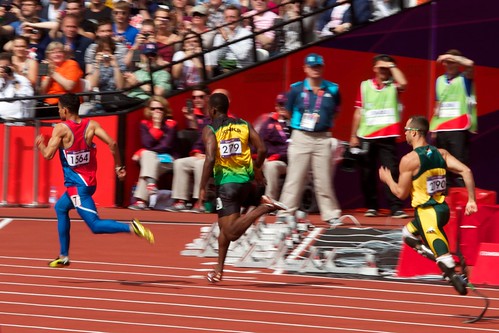
South African sprinter Oscar Pistorius just made history as the first double amputee to participate in the Olympic games, and the first amputee to take part in track events. Born without fibulae, Pistorius had his legs amputated below the knee before he was a year old.

Hugh Herr is an associate professor at the MIT Media Lab. An avid mountain climber, as a teenager he was caught in a blizzard while climbing in New Hampshire. After spending three nights outside in below-zero temperatures, he suffered severe frostbite and had to have both legs amputated below the knees. Not only did he walk again, he began climbing again using self-designed prostheses. [At left, Herr on the climbing wall at the Lab's h20 event. Photo: Webb Chappell]

Herr was an expert witness in the court case that resulted in the reversal of the ban preventing Oscar Pistorius from competing in the Olympics. We asked him a few questions about the science behind how Oscar runs.

What kinds of challenges does Oscar Pistorius have to overcome when racing with prosthetic legs?

Hugh Herr (HH): Oscar faces three dominant problems when racing with the Cheetah prosthesis. First, the Cheetah springs are passive, and therefore do not change stiffness during a running step. Consequently, Oscar's vertical ground forces are compromised, negatively impacting his running speed—that is, he can't push off the ground as hard, which reduces how fast he can run.

Second, Oscar's passive prostheses only return the energy that Oscar puts into them, actually less energy due to hysteresis. In contrast, the human ankle-foot complex is muscle powered and thus can propel a runner forward out of the running blocks during the acceleration phase of a race. Although the acceleration phase of the race has never been studied, it's likely that Oscar suffers from a lack of ankle power during this period of the race.

Finally, Oscar's prostheses are attached to his residual limb using a prosthetic socket that can often be uncomfortable and unstable. When Oscar sweats, his biological leg would become attached less securely to the artificial leg, possibly causing a degradation of performance.

How are ‘Cheetah blades’ different from other types of prosthetics? How do they work?

HH: The Cheetah prosthesis is designed specifically for running, and not for other activities such as walking. The Cheetah is shaped like a 'C' and is made from carbon composite, a highly elastic material for storing and releasing spring energy.

Do you think we’ll see other athletes like Oscar competing in the Olympic Games moving forward?

HH: Other persons with leg amputations may qualify for the Olympic games in the future, but it may be a very long time before another athlete is capable of qualifying. Oscar is a gifted and tenacious athlete.

Oscar Pistorius
Oscar Pistorius runs in the 2012 Summer Olympics. Photo: Paul Williams | CC BY-ND 2.0

What other kinds of prosthetics are being developed at the Media Lab?

HH: The Media Lab's Biomechatronics group designs computer-controlled bionic limbs for walking and running. A recent invention is a powered ankle-foot bionic limb that has been shown to normalize the biomechanics and energetics of walking. [At left, Herr with a variety of prototyped prosthetics. Photo: Webb Chappell]

Tuesday, August 7, 2012

Learning Through Connecting

Much of the discussion about educational technology these days focuses on new ways to deliver instruction, through online videos and online courses. In our Lifelong Kindergarten research group at the Media Lab, we have a very different approach to education and learning, developing technologies not to deliver instruction but to open opportunities for people to create, collaborate, experiment, and express themselves. With our Scratch programming software, for example, young people can create their own interactive stories, games, animations, and simulations, then share their creations with one another online. In the process, young people learn to think creatively, reason systematically, and work collaboratively – essential skills in today’s society.

Last week, we had an opportunity to see how this learning approach is taking root in different parts of the world, as we hosted our third Scratch@MIT conference. More than 400 educators, researchers, and developers from 31 countries came to the Media Lab for four days to share stories, plans, and visions about Scratch.

One unifying theme at the conference was the use of Scratch to encourage and support many different types of connections:

  • Connecting with ideas. In one of the keynote sessions, five educators and five third-grade students from a school district in New York demonstrated how they are using Scratch as part of a “computational thinking” curriculum unit, highlighting how programming activities can provide opportunities for students to engage with important math, science, and engineering ideas. Students weren’t just learning Scratch; they were learning with Scratch.

  • Connecting with interests. In session after session, it was clear that the best Scratch learning experiences happen when people have an opportunity to build on their own interests. There were examples of young people using Scratch to create simulations of environmental issues affecting their communities, games featuring characters from their favorite books, and animated stories with original soundtracks.

  • Connecting with the physical world. Increasingly, Scratch projects are stretching off the computer screen, connecting to sensors, motors, and other devices in the physical world. A researcher from Ireland demonstrated a way to use Microsoft Kinect to control Scratch projects with body gestures, while researchers from Japan introduced a low-cost sensor board for controlling Scratch projects.

  • Connecting with people. Many sessions at the conference highlighted the social nature of learning. Some presentations described how young people in different countries are collaborating on projects through the Scratch online community. Other presentations showed how educators are creating Scratch sub-communities within their countries.

Although the Scratch@MIT conference happens only once every two years, our research group is always working to nurture, sustain, and extend all of these connections. The ScratchEd website enables educators around the world to share stories, exchange resources, and connect with one another. And later this year, our group will launch a new generation of Scratch, called Scratch 2.0, that will enable people to create projects directly in the web browser, opening new opportunities for creativity and collaboration with Scratch.


Mitch Resnick is Professor of Learning Research and Director of the Lifelong Kindergarten research group at the MIT Media Lab.

Karen Brennan, a PhD student in the Lifelong Kindergarten group, chaired the organizing committee for the Scratch@MIT conference.