Tuesday, January 31, 2012

The Festival of Learning

Do you see differences in your organization as an opportunity or a problem?

The Media Lab is an antidisciplinary organization packed with inventive doers. We cultivate a positive ethos of creative difference. How do we find strength in what many organizations fear? As a first-year research assistant, I'm still learning our culture. But at last weekend's Festival of Learning, I think I found the answer.

Over two days, the Festival of Learning invited anyone in our buildings to learn, teach, and do things together. It included students, staff and faculty across the Media Lab, Comparative Media Studies, the GAMBIT Game Lab, and MIT's Program in Art, Culture and Technology.

Our wonderfully diverse range of sessions (list here) included Making Mochi, Winter Survival Tips from a New Englander, Media Lab Research Methods 101, How to Release a Free Software / Open Source Project, Cardboard Forts, and hacking a disco office lighting system.

As coordinator of the festival and part of the organizing team, I ran out of exclamation marks very quickly.

Skill-sharing across hundreds of people is a remarkable act of courage and faith for any organization. To faciliate that two-month planning process, we prototyped a LEGO Ideas Board, designed a skill-share web app, and distributed a video trailer through every possible mailing list. I think our personal conversations were the most effective. Face-to-face encouragement is a wonderful way to build everyone's confidence and nurture genuine trust.

The seeds for the Media Lab's Festival of Learning were planted in the orientation weekend that every new Media Lab student experiences. Mitch Resnick asks everyone to write something they can teach onto a whiteboard. After each student chooses what we want to learn, we meet up later for a learning session, report back, and share with each other what we learned. We also reflect as a group on the process of teaching and learning. In this small skill-share, we learn to respect each other for our diversity and to see each other as more than just our research topic.

Many life-defining learning experiences come from unexpected corners—sports, films, toys, music. We expect this for children, but somehow many adults lose the plot, and our passions become private. At the Festival of Learning, Joi Ito taught us about leadership using MMORPGs, Charlie Nesson taught strategic thinking via poker, and Joe Paradiso and Ian Condry led us to explore Japanese culture through Hip Hop and Extreme Rock. Scott Nicholson showed us how to overcome shyness through face painting. Ethan Zuckerman trained us to be CEOs (certified effervescence operators).

At the Festival of Learning, we set out to transform our everyday working space into a place for new possibilities. We turned the atrium into a picnic area. We filled a room with balloons. Media Lab sponsor LEGO donated a suitcase of minifigures, including Lego Friends, for us to design our own characters. On Saturday, a floating shark swam around the festival.

So how can an organization find strength within creative difference? Share our differences with each other. The all-volunteer Festival of Learning was motivated by love, inspiration, and delight. It required a lot of good faith by everyone. I'm delighted to see that faith rewarded by such a wonderful learning experience—a festival that reflects the true strength and diversity of the Media Lab and our neighbor groups at MIT.

Monday, January 30, 2012

The New Deal on Data

Prof. Alex Pentland, MIT Media Lab and IDcubed.org

Science, and the idea of natural law, can help us reinvent our society to be more stable, fair, and efficient. The idea of natural law began in the 1700s, when philosophers realized that the laws of society should be matched to human nature. The founders of the United States believed in natural law, and chose as their model of human nature individuals continually competing for money and seeking power.

But is this really us? Are we doomed to eternal fights for money and dominance? The wars of the last century might suggest so, but that same century saw unprecedented progress in life expectancy, poverty eradication, and political inclusion. So if we aren’t creatures of eternal competition, then what are we?

The scientific evidence is that pre-agricultural societies were egalitarian, supported the weak–and yet were also efficient. However, they were not based on open competition, but instead on private exchanges within social networks. Each person had special skills and information, and these were traded to others for food or favors. You bargained one at a time with the people you trusted, and the influence of the rich and powerful was limited.

So it would appear that philosophers of the 1700s got natural law WRONG. Unbridled competition is not natural law for humans. But as a result of their mistake we have been left with a legacy of unstable banks, unfair governments, and inefficient companies. Instead of unchecked competition, modern science says that human natural law is: trade with the people with whom you have trusted relationships, instead of fighting with faceless organizations or market machinery. So why should you care? We aren’t likely to re-write our government constitutions anytime soon!

But increasingly we are using digital social networks to reinvent our society, and we have the opportunity to build this new society using scientific insights about human nature. We can shape this new digital society around a new, a more accurate version of natural law. By encouraging interactions within trusted relationships rather than promoting unbridled competition, we can create a more fair, stable, and equitable society.

So, how does this work? The key is that individuals have rights in their virtual, digital selves that mirror the rights they have in their physical selves. You should control data that is about you, how it is used, and where it goes. Your interactions should be guided by trusted relationships rather than being subjected to nameless others.

This framework is called the New Deal on Data, and it has surprising mathematical properties. By giving people control of their digital selves, we can build a system that is more stable and more fair than today’s market-based systems. In the past, the costs of communication limited such systems to small scales, such as town-hall meetings. But thanks to the power of modern digital networks, these grassroots systems can now scale to planetary size and still be efficient and innovative.

Imagine user-controlled banking where you could direct your money to community projects that you cared about, and yet still control risk and return. We could fulfill the dreams of micro-credit and community lending, but without sacrificing performance or scale. Or imagine citizen-controlled government where you could direct where your taxes go and shape your local laws. You could achieve the ideals of local governance, but without sacrificing safety, fairness, or efficiency.

So how can the New Deal on Data become real? At the World Economic Forum we have achieved a remarkable consensus among governments, companies, and advocacy groups. This consensus contributed to last week’s announcement declaring the elements of the New Deal as being basic human rights–that is, as being natural law. To help bring the New Deal into everyday life, we at the MIT Media Lab and at IDcubed.org have developed the open-source software and legal frameworks needed to field test the New Deal at sites around the world.


Alex 'Sandy' Pentland is Toshiba Professor of Media Arts and Sciences and heads the MIT Media Lab's Entrepreneurship Program.

Sunday, January 15, 2012

The Media Lab is against SOPA and PIPA

As many of you may be aware, there are two bills being considered by the US Congress - the Stop Online Piracy Act and the Protect IP Act - better known as SOPA and PIPA. While the goal to try to minimize the dissemination of copyrighted materials online is laudable, the bills are misguided and dangerous and could damage innovation on the Internet and limit free speech.

A number of organizations have spoken up publicly against the bills and a number of the Media Lab community members, including myself have been actively opposing the bill. Today the Media Lab would like to officially go on the record opposing the bill as well.

We encourage you to learn more about these bills, develop your own opinions and participate in the debate and collective action. It's a critically important moment for internet freedom and these bills could have a very negative repercussions both in the United States and globally.

You can read more about the issue on Ethan Zuckerman's blog and my blog where we have cross-posted a longer post on the topic.

Tuesday, December 20, 2011

Welcome Sep Kamvar

I have great news.

We will be welcoming Sep Kamvar as the Media Lab's newest faculty member as of January 1, 2012. He will be joining us as the LG Associate Professor of Media Arts and Sciences, heading the Social Computing research group. He will be located in the East Lab, on the second floor of E14.

Sep comes to us from Stanford University, where he earned his PhD and is currently consulting assistant professor at the Institute for Computational and Mathematical Engineering. To date, his most significant contributions have been at the intersection of computer science and mathematics, particularly in the fields of personalized search and peer-to-peer networks. For four years, he took a leave from his graduate work to found a personalized search company, and then, when Google acquired the company, built and led Google’s engineering efforts in personalization. His artwork has been exhibited at The Museum of Modern Art and the Victoria and Albert Museum.

You can see the talk that Sep gave at the Fall meeting in October.

I'm really excited by Sep's research areas, his deep ties with Silicon Valley and the thoughtful, fresh and exciting energy that he brings. Yay!

Tuesday, November 29, 2011

How Does Society React When Technology Approaches Magic?

[Graduate student Matt Stempeck shares his notes from today's talk by frog design's Chief Creative Officer Mark Rolston.]

The audio fidelity on the #MediaLabTalk livestream wasn't great at first, so I attempted to liveblog. Unfortunately I had to head to class as the second speaker, Jared Ficklin, came on, but we'll be posting video shortly.

Mark Rolston, Chief Creative Officer of frog design, has been with frog for years and has seen the company grow to include strategy.

He believes that companies want to innovate, but that the need to scale and manage complicated supply chains impedes their ability to do so. Some companies are failing to simply build the most innovative product but even more so, to integrate with rest of the product ecosystem to design the entire customer experience.

Frog's experience in the 1980s associating an emotional, ephemeral experience with drinking Coke, which is essentially brown sugar water, has proven useful decades later in designing meaningful software interactions and making virtual experiences richer. (The slide showed a Classic Coca Cola bottle, not New Coke ;-)).

Science fiction has been great at predicting what's to come (by taking plenty of shots, complete with plenty of misses), but it's often been about better aligning ourselves with computers.

A slide shows how the cellphone has replaced So. Many. Functions.

Products like a crown, a scepter, a totem still have deep meaning beyond their physical use, haven't made the jump to digital experience yet.

Our experience with computing has gone something like this:

  • First wave: Users are operators, like operators of heavy equipment, without a real connection to the data
  • Second wave: Slide shows an iPhone. More personal relationship, we carry it with us; we're babysitters
  • Third wave: Slide shows humorously early wearable technology from the Media Lab. The third wave's going to look more like Hal, and consume your entire environment, an invisible layer when you're doing something else like cooking, bathing.

A slide shows the many parts (microphone, screen, processor) that go into a computer, and Mark suggests that computing has become and will continue becoming decoupled. Even the smallest, sleekest computer today will be surpassed by the decoupling of the concept of computing. Computers will not be composed, fixed assemblies of parts, but a set of possibilities between objects that are talking to one another. Computing will always be with you, and won't be something you carry, but rather a diffuse infrastructure.

The entire world is the platform. Mark makes the point that the city is the new computer. It's a contained but still open space of sensors and people and inputs, of network sensors and interfaces.

The challenge, and less obvious part, is now to move from the private computing experience we're used to into a shared experience. Even with digital sharing, consumer electronics have been designed for the individual. A diffuse computing environment inherently includes many people and common experiences.

Frog design took over every screen in Times Square for GE's World Health Day in 2007 with nothing but a PowerMac Pro in a closet and a VGA cable (at the technical level, at least). It was a nice early example of computing at scale, with thousands of people computing simultaneously.

Mark segues into the fact that we've always had a private life and a public life, and there's been relatively little bleed between the two. Sure, we wrote private letters that became public, but they were a relatively low-fidelity medium. But now the two lives are being tangled. Mark quotes Alfred Korzybski, saying, "The map is not the territory." The public image of us has not been an accurate representation of who we really are. But now our maps are becoming their own territory as our private lives go online in high fidelity.

We'll change as much as computing does, Mark says, with an emerging second brain, second life. We have augmented selves. [We can sign up to get knock knock jokes via text and everyone will think we're really funny].

Mark shows a product created years ago, which listens to your conversations and conducts intelligent web queries to augment your knowledge when someone asks you, for example, about the football game last night. They found that this technology itself drove the conversation in a new direction and dominated the original topic–the map overtook the territory. [I'd consider this a failure of the goals of an augmented technology–technology should blend in with our existing social interactions, not completely disrupt them].

Another form of knowledge augmentation is "decision support." Intel sponsored a display to help people pick out outfits at a department store. Again, the question of a shared, embedded computing experience rather than an individual, personal, outfit-selection tool brought up new questions.

One of the most exciting dynamics possible with augmented information is that it grants us new superpowers for social advantage. Ubiquitous computing can help us know more intellectually or socially or give us more basic social warmth. This brings up the question of what it means to know something. There's a difference between someone truly knowing your birthday vs. your Facebook friends "knowing" your birthday. The impending social ramifications can't be overstated.

Mark brings up the example of the film Up in the Air, where everyone in the airline industry, including computer systems, knows George Clooney with a level of false, commercial intimacy, and the movie makes a clear comment on this false life and the opportunity cost of Clooney's character missing out on real connection.

Mark confronted these questions of digitally enabled, real-time knowledge head on at a conference, where the organizers had given everyone a SpotMe tool. It lets you see everyone's name, title, background, and where in the room they are. You can literally go find people as if you have social sonar. The tool basically makes each of us a node in a network, and exposes all of the social information that's normally revealed via conversations and introductions. There are clearly strong benefits and drawbacks to such a tool.

Each of us has a variation of the human brain, and networking them normalizes our differences, to the point that only the loudest obnoxious voices online cause a spike (with implications for our politics).

Handing over agency to a machine requires a level of trust. Mark shows a great video clip of TED attendees taking one of Google's self-driving cars for a spin for the first time. Almost everyone has a freakout moment as the car speeds around and steers itself. It makes us uncomfortable and we question handing over agency to computers/robots.

Frog found this out firsthand when they designed medical devices and pill reminders. Mark says that statistics show that doctors regularly give incorrect advice but are pretty well protected in doing so by the legal system. But a much, much more accurate digital device suffers a much worse fate when it occasionally dispenses the wrong advice. Suing a computer is apparently much easier than suing a doctor. If we allow the Siris of the world to take the next step in intelligence, from dictating existing information to actually making original recommendations, we're going to have to deal with the social and legal ramifications.

Mark thinks one of the terms were going to need to use in a better way is 'magic,' when computing objects escape their mechanical origins and pick up more of the ephemeral. The word 'magic' has historically been owned by charlatans and zealots, but we're going to have to build a new vocabulary of the high mind to take into account our new affordances.

[And, according to event attendee Dan Novy, "The Object-Based Media Group regularly uses the term "Magic" to describe what our goals and design philosophies are."]


Matt Stempeck is a first-year graduate student at the Media Lab / Center for Civic Media.

Thursday, November 17, 2011

Media, Freedom, and the Web: Civic Media at the Mozilla Festival

The Mozilla Festival on Media, Freedom, and the Web (Nov 4-6, hashtag #mozfest) was three days in London of "less yack, more hack" focused on journalism and media technologies. The attendees brought together a great convergence of organizations that care about journalism, media, social good, education, open platforms, and web technologies. The weekend held a rich schedule of design challenges, learning labs, and fireside chats, offering everyone opportunities to meet, plan, make, and reflect on media and the web.

The overall conference theme centered on protecting and nourishing a read/write web. During the final event, speakers emphasized the importance of supporting technology and cultures that people around the world can use to make content, tools, and games, rather than simply consume them. There was a general sense that beautiful but confined “walled gardens” and closed technologies diminish the open web–and, by extension, innovation. To preserve the open spirit and capabilities that flourish on the Internet, we must protect the ability to do things like view source code, remix content, and more generally learn how to make.

During the festival, the Mozilla and Knight Foundations announced the 2011/12 Knight Mozilla News Technology Fellows, including the Media Lab's very own Dan Schultz. The Knight Mozilla fellowships form an exciting open innovation initiative: fellows will be embedded software developers at Al Jazeera, the BBC, The Boston Globe, the Guardian, and Zeit Online. As they make technologies for their own news outlets, the fellows will also collaborate with each other to develop open-source technologies to advance the future of news.

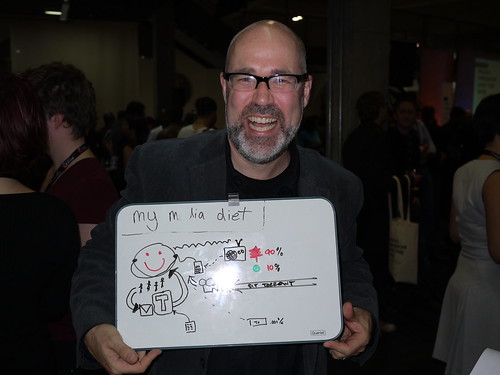
Matt Stempeck and I went to the festival to collect ideas for an exciting new project at the Center for Civic Media: technology to track your media diet. Led by our director Ethan Zuckerman, this project will track the content that media organizations and bloggers publish over time, as well as allow consumers to set goals for their own media consumption (Ethan spoke about this at the Lab's fall 2011 meeting). At the Mozilla Festival, we asked journalists, film-makers, and developers to draw their media diet, and held a design discussion about nutritional labels for the news. I love the smiley face on Mozilla Foundation executive director Mark Surman's media diet. Mark also taught me a new word to use when praising others: lovebombs.

Lovebombs (noun, plural)

Example: "Major lovebombs to Michelle Thorne, Mozilla and Knight for a great conference!"


P1060135
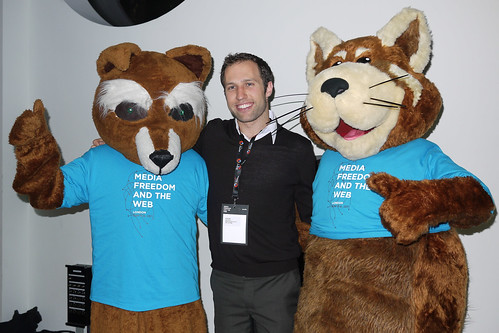
Matt Stempeck and some new friends

P1060143
Mozilla Foundation Executive Director Mark Surman's media diet

My favorite part of the Festival was the Hive London Popup for Teens, a series of sessions bringing together youth education organizations from across America and Europe. Instead of just talking with each other, we learned from each other by teaching young people in the same open space. I brought along Aago, a Center for Civic Media project for youth media production. I also had a lovely time introducing young people to Scratch. Before joining the Media Lab this year, I helped found a creative writing center in London, so it was fun to work with London teenagers once more!

Overall I had a wonderful time at the Mozilla Festival. We met some great civic organizations, hacking and yacking with a fascinating range of people. The Knight Foundation funds the Center for Civic Media, and I really enjoyed meeting people within the Knight-Mozilla circle.

The UK was my home for 5 years until I left London in July to join the Media Lab. I admit I felt wistful as I walked the streets I love so well. But surrounded by my new Media Lab colleagues, in the company of the exciting innovators at the Mozilla Festival, I am excited and inspired about what we can do together for media, freedom, and the web.

Here’s more:

Civic Media
"Civic Media Goes to London, Part One"
"Putting Voldemort into the Guardian: Remixing the News with Hackasaurus"
"Designing a Nutritional Label for the News at the Mozilla Festival"
"Discussion with Bilal Randeree on Liveblogging at Al Jazeera"

Nieman Lab
"Ethan Zuckerman Wants You To Eat Your News Vegetables"
"How Social Guilt can Change Our Media Habits or Just Make Us Lie About Them"
"Lessons from the Mozilla Festival: How the Knight and Mozilla Foundations are Thinking about Open Source"

Mozilla Knight News Tech Fellow Laurian Gridinoc: "Visualising my News Diet"

Knight Foundation
Knight News Challenge 2012 Preview
Highlights from the Mozilla Festival

Nathan Matias: "Technology Tent, Occupy London"

Open Knowledge Foundation: "Hacks and Hackers Gather to Write the First Data Journalism Handbook"

J. Nathan Matias is a first-year graduate student researching media consumption, creative learning, and community co-design at the Center for Civic Media.

Matt Stempeck is a first-year graduate student researching political identity and how people change their minds, at the Center for Civic Media.

Dan Schultz is a second-year graduate student in the Information Ecology group and the Center for Civic Media, researching tools to help people consume information more carefully.